PRIVATE PDF DOCUMENT ASSURANCE · BUILT WITH OVERLIFT

Vellucent Studio

Fix the writing. Preserve the record.

Vellucent understands language as it actually lives inside a PDF—across pages, headings, tables, citations, forms, and defined terms. It proposes focused corrections for sensitive, regulated, and government documents while preserving the original, protected meaning, and reviewer control.

See the document-assurance workflow Follow the product story
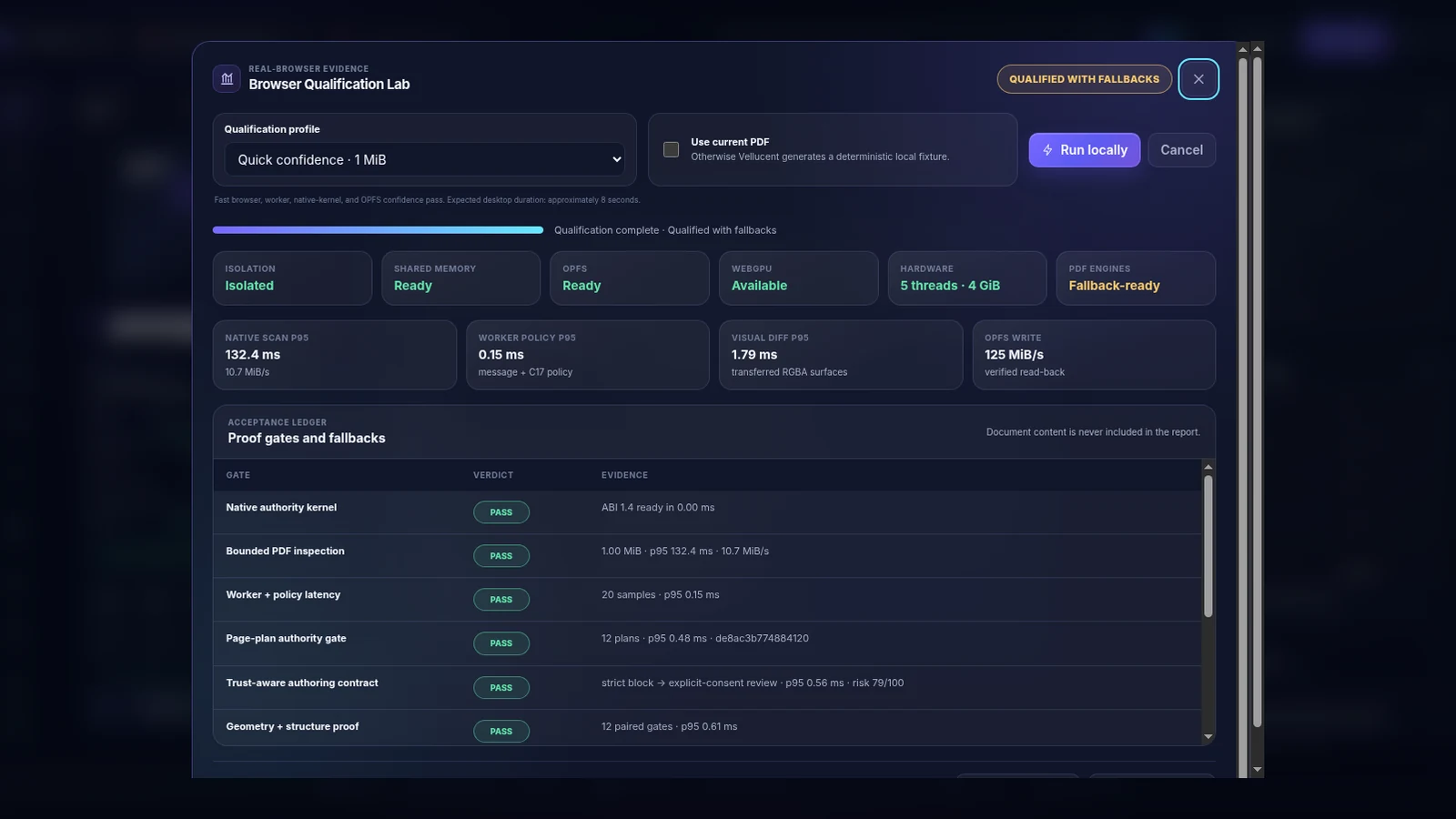
Vellucent Studio browser qualification laboratory with local capability checks and proof gates
Real product view The product is shown before the deeper technical story.
  1. 01
    Page-awareKeep every proposal tied to the real page, object, text span, and document revision.
  2. 02
    Meaning-safeProtect names, numbers, obligations, citations, defined terms, and consequential intent.
  3. 03
    Reviewable proofPreserve the original and issue a receipt for every accepted or refused change.
MARKETING

Make the useful difference easy to understand and remember.

The complete audience, competitive, and positioning story begins here.

A private-by-default PDF assurance workspace for sensitive, regulated, and government documents. It combines page-aware evidence, exact and semantic retrieval, proposal-only grammar agents, Meaning Lock, human review, verified derivatives, and receipts so better writing never outranks the record.

Why it stands apart: Generic PDF copilots flatten structure and treat fluent output as success. Vellucent retains page/object anchors, separates exact evidence from learned interpretation, measures required corrections and KEEP cases, protects consequential meaning, refuses unsafe changes, and preserves a reversible proof of every decision.

PRODUCT SIGNALSWhy people notice and remember the product
  1. 01Private PDF intelligence
  2. 02Meaning-safe grammar proposals
  3. 03Government and regulated documents
  4. 04Lower document exposure and cloud dependency
  5. 05Traceable, reversible corrections for government and regulated review
  6. 06Faster review without silent source mutation
BUSINESS / EXECUTIVE

Reduce review time and disclosure while protecting defined terms, facts, reviewer authority, revision history, and audit evidence.

Improve consequential PDFs without surrendering source truth, privacy, meaning, reviewer authority, or control of the original record.

The business and government value is faster review of complex PDFs with lower disclosure, protected facts and policy language, explicit reviewer authority, immutable originals, and a durable audit trail for every accepted or refused proposal.

Executive case: Generic PDF copilots flatten structure and treat fluent output as success. Vellucent retains page/object anchors, separates exact evidence from learned interpretation, measures required corrections and KEEP cases, protects consequential meaning, refuses unsafe changes, and preserves a reversible proof of every decision.

VALUE AND PROOFWhat a leader can defend, measure, or operationalize
  1. 01Lower document exposure and cloud dependency
  2. 02Traceable, reversible corrections for government and regulated review
  3. 03Faster review without silent source mutation
  4. 04Local PDF and fixture processing without document content in the qualification report
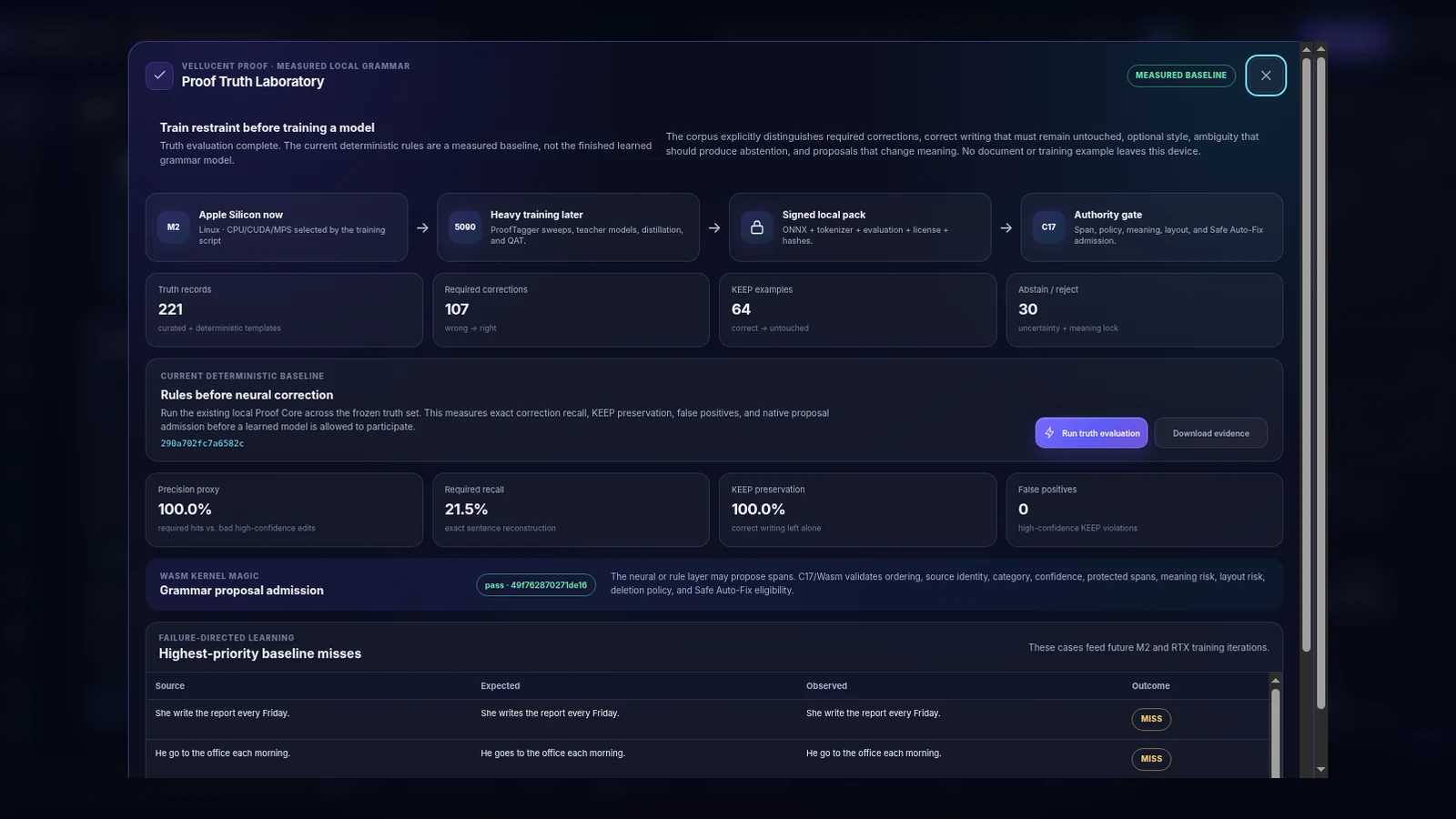
  5. 05Separation of required corrections, preserved writing, ambiguity, and meaning risk
  6. 06Sentence reconstruction and failure-directed evaluation surfaces
ARCHITECTURE

An immutable PDF source becomes a page- and object-aware evidence graph before exact retrieval, local semantics, or grammar agents may propose an operation.

Deterministic Proof Core and JavaScript/C17-WebAssembly Meaning Lock are active. A pinned same-origin MiniLM runtime is acquired and recovered automatically, executes in an isolated worker, and remains behind native learned-output admission. The current Semantic Bridge still uses its deterministic projection until the learned 384-dimensional path is owner-qualified; ProofTagger, BERT Tiny, and DistilBERT remain candidate grammar systems rather than a claimed production winner.

I built Vellucent Studio as a private-first document workstation. The browser qualifies its own capabilities, processes local document fixtures, measures proofreading truth, separates required corrections from writing that must remain untouched, and admits only structured proposals that pass deterministic policy and meaning checks.

Authority boundary: OverLift gives agents room to inspect, retrieve, and propose while denying ambient document authority. Exact source identity, explicit capabilities, Meaning Lock, approval, deterministic operations, verification, receipts, replay, and recovery decide what may become an official derived revision.

  1. 01

    Check what the current browser can safely do before opening the workflow.

  2. 02

    Keep the source document local while extracting structure and searchable evidence.

  3. 03

    Let rules or models propose a correction, classification, or transformation.

  4. 04

    Compare the proposal with protected text, meaning, confidence, and layout policy.

  5. 05

    Ask the user to accept, reject, or revise the proposal.

  6. 06

    Preserve the accepted operation so the document can be inspected or reversed.

ENGINEERING

Proof Core, Meaning Lock, bounded workers/WebAssembly, explicit capabilities, human approval, verified derivatives, receipts, replay, and rollback.

Vellucent is a document-assurance system rather than an AI PDF wrapper: immutable source, page-aware evidence graph, private retrieval, proposal-only agents, Meaning Lock, typed capabilities, human approval, verified derived revisions, recovery, and replayable receipts.

I designed the document-computer architecture, local execution boundary, proof and truth corpus, grammar proposal contract, Meaning Lock safeguards, browser qualification workflow, and the product interface that makes privacy and fallbacks visible.

Technology stack.NET 10, C17/WebAssembly, OPFS, WebGPU, ONNX Runtime Web, local RAG, optional multimodal model routing
IMPLEMENTED ENGINEERINGWorking systems and verified boundaries
  1. 01Browser qualification and local capability evidence
  2. 02Proof Truth corpus and deterministic grammar-proposal admission
  3. 03Private-first document workflow with visible fallbacks and review gates
  4. 04Page-aware PDF evidence with source, object, geometry, revision, and uncertainty anchors
  5. 05Correct, preserve, review, or refuse through Proof Core and Meaning Lock
  6. 06Local-first semantic proposals with explicit capability, approval, verification, and receipt boundaries
OVERLIFT METHOD

How OverLift makes Vellucent Studio adaptive without surrendering authority.

OverLift gives agents room to inspect, retrieve, and propose while denying ambient document authority. Exact source identity, explicit capabilities, Meaning Lock, approval, deterministic operations, verification, receipts, replay, and recovery decide what may become an official derived revision.

  1. T0
    Exact baseline

    Define the authoritative result before adding acceleration, semantics, or agents.

  2. T1
    Measured evidence

    Instrument state, latency, quality, and failure so improvement is observable.

  3. T2
    Bounded ownership

    Move expensive or high-frequency work behind clear worker and memory boundaries.

  4. T3
    Deterministic transport

    Version messages, snapshots, identities, deadlines, and replay inputs.

  5. T4
    Semantic assistance

    Let local retrieval and models propose meaning only inside admitted evidence.

  6. T5
    Candidate paths

    Compare several allowed next actions with explicit risk, cost, fit, and uncertainty.

  7. T6
    Shadow verification

    Challenge the production route without giving the challenger authority.

  8. T7
    Governed production

    Promote only measured, replayable paths with fallback and operational receipts.

  9. Tier-S
    Experimental challenger

    Run advanced evaluators in shadow, compare them with the control, and graduate only repeatable gains.

CATS

Context-Aware Tier Selection

CATS chooses the least risky qualified execution tier for the current evidence, device, latency, authority, and failure context. The product does not run its most advanced path merely because it exists.

SEMANTIC BRIDGE

Meaning becomes typed product state

The Semantic Bridge translates human goals, documents, events, or observations into explicit entities, evidence, uncertainty, tools, and permissions. It preserves missing and contradictory information instead of smoothing it away.

DETERMINISM

One official result, evidence, and replay path

Models may retrieve, classify, compare, or propose. Exact software remains the authority over admitted facts, legal actions, state transitions, approval, execution, and the receipt that proves what happened.

Read the complete OverLift Method Explore OverLift security Run the OverLift demonstration Explore the Agentic AI Glossary
BROWSER-BASED AGENTIC AI SYSTEM

The private, government-ready document-assurance vertical inside the Browser-Based Agentic AI System.

Vellucent Studio is one vertical proof inside a wider browser-based system. The point is not to force every product through identical technology; it is to apply the right combination of local intelligence, retrieval, sandboxing, explicit capabilities, agents, deterministic authority, and proof without turning any of them into marketing checkboxes.

CAPABILITY PROOFWhat is active, shared, bounded, or authoritative in this product
  1. 01 ACTIVE IN PRODUCT

    Browser-native product surface

    The working interface, local execution path, or browser-class runtime makes the system inspectable, portable, and available without hiding the product behind an API demo.

  2. 02 ACTIVE PRIVACY BOUNDARY

    Privacy and minimum disclosure

    Sensitive context is processed locally, same-origin, or offline where the product benefits. Any provider-bound step is intentionally scoped instead of receiving the complete product history.

  3. 03 ACTIVE IN PRODUCT

    Narrow agents and typed tools

    Agents receive bounded context, explicit capabilities, deadlines, and typed tools. They may retrieve, classify, compare, explain, or propose; they may not silently expand their own authority.

  4. 04 ACTIVE IN PRODUCT

    RAG and vector evidence

    Local or governed retrieval builds an evidence set before reasoning. Vector similarity proposes useful context, while source identity, freshness, access, and deterministic admission decide what the product may trust.

  5. 05 ACTIVE IN PRODUCT

    C17 / WebAssembly kernel

    A WebAssembly authority path keeps exact state, validation, and replay separate from probabilistic assistance. Faster or more creative layers cannot redefine the official result.

  6. 06 ACTIVE SECURITY BOUNDARY

    Security and least privilege

    Workers and WebAssembly narrow parsing and inference; runtime/model assets are integrity-checked; capabilities, source spans, permissions, lifecycle, and required roles are explicit. Embedded instructions remain document content, learned output cannot bypass Meaning Lock or approval, credentials remain server-side, the immutable source cannot be silently overwritten, and verification fails closed.

  7. 07 ACTIVE IN PRODUCT

    Receipts, replay, and evaluation

    Important inputs, candidate paths, approvals, state changes, and outcomes remain inspectable through receipts, traces, reversible operations, replay, or exact comparisons appropriate to the product.

Evidence-bound RAG Source and identity checks Narrow agents Typed tools Sandboxed execution Explicit capability allowlists Least privilege Local-first privacy Minimum disclosure Human approval Abstention and fail-closed paths Receipts, replay, and evaluation
What this proves The Browser Qualification Laboratory shows the local capabilities and fallbacks that are actually available. The Proof Truth Laboratory measures corrections, preservation, abstention, and false positives before a learned model is trusted. The screens expose the gates instead of hiding them behind a single accuracy number.
GOVERNMENT AND REGULATED DOCUMENTS

Proofread the language. Preserve the record. Prove the decision.

Vellucent is built for PDFs where a polished sentence is not enough: policy, procurement, reports, grants, regulations, forms, contracts, technical publications, and records whose facts, defined terms, citations, obligations, and revision history must remain defensible.

01
Immutable PDF source

Bind every operation to document identity, revision, page, object, text span, geometry, and uncertainty.

02
Page-aware evidence graph

Reconstruct logical sentences without discarding reading order, headings, tables, forms, annotations, or source anchors.

03
Local semantic proposal

Use exact terms, same-origin MiniLM context, Proof rules, terminology, policy, and bounded grammar candidates to propose—not commit.

04
Meaning and capability gates

Protect names, numbers, dates, money, citations, negation, modality, comparison direction, defined terms, permissions, and lifecycle state.

05
Reviewable derived revision

Preview the operation, require the proper reviewer, verify the result, preserve the original, and issue a replayable receipt.

MISSION VALUE

Controlled language without a cloud-first dependency

Agency terminology, acronyms, form labels, policy clauses, prior decisions, and hard-negative examples can support review inside the controlled application boundary.

SECURITY

Untrusted documents never inherit ambient authority

Workers, WebAssembly, hash-pinned local assets, explicit capabilities, server-side credentials, source-span checks, permission checks, and fail-closed admission reduce the blast radius of malformed content and unsafe output.

SAFETY

Correct, preserve, review, or refuse

Meaning Lock can block a grammatical proposal that changes a protected fact, obligation, certainty, negation, comparison, identifier, quotation, citation, or defined term.

PRIVACY

Keep the private first pass local

Core parsing, retrieval, proof analysis, and proposal handling can remain local or within an agency-controlled deployment. Optional providers receive only an approved passage and declared capability.

AUDITABILITY

Bind the source, proposal, authority, decision, and result

A receipt can retain document and revision hashes, page and object anchors, rule/model identity, evidence, Meaning Lock verdict, policy, reviewer, output hash, and verification result.

RECORD INTEGRITY

The original remains the original

Accepted changes create labeled derived revisions. Structural edits do not pretend that a prior digital signature remains valid, and automatic PDF grammar writes stay disabled until preservation and rollback gates pass together.

ACTIVE

Deterministic Proof Core, JavaScript and C17/WebAssembly Meaning Lock, page-aware source anchors, local proposal receipts, and same-origin MiniLM acquisition/admission architecture.

QUALIFICATION-GATED

The learned 384-dimensional Semantic Bridge, a selected production grammar model, image-only OCR correction, and verified automatic PDF writes remain behind explicit owner, quality, preservation, and recovery gates.

PRODUCT PROOF

These are real project views from the actual work—not generic stock illustration. They connect the product story to an interface, workflow, or result a visitor can inspect.