PRIVATE GUIDED WELLNESS · BUILT WITH OVERLIFT

TherapyLink.AI

A safer next step for a sensitive question.

TherapyLink.AI helps a person turn a difficult, sensitive question into a calmer and more useful next step. It can organize concerns, surface relevant options, preserve consent, and explain uncertainty without pretending to diagnose or quietly escalating the user into an action they did not approve.

See the guided experience Follow the product story
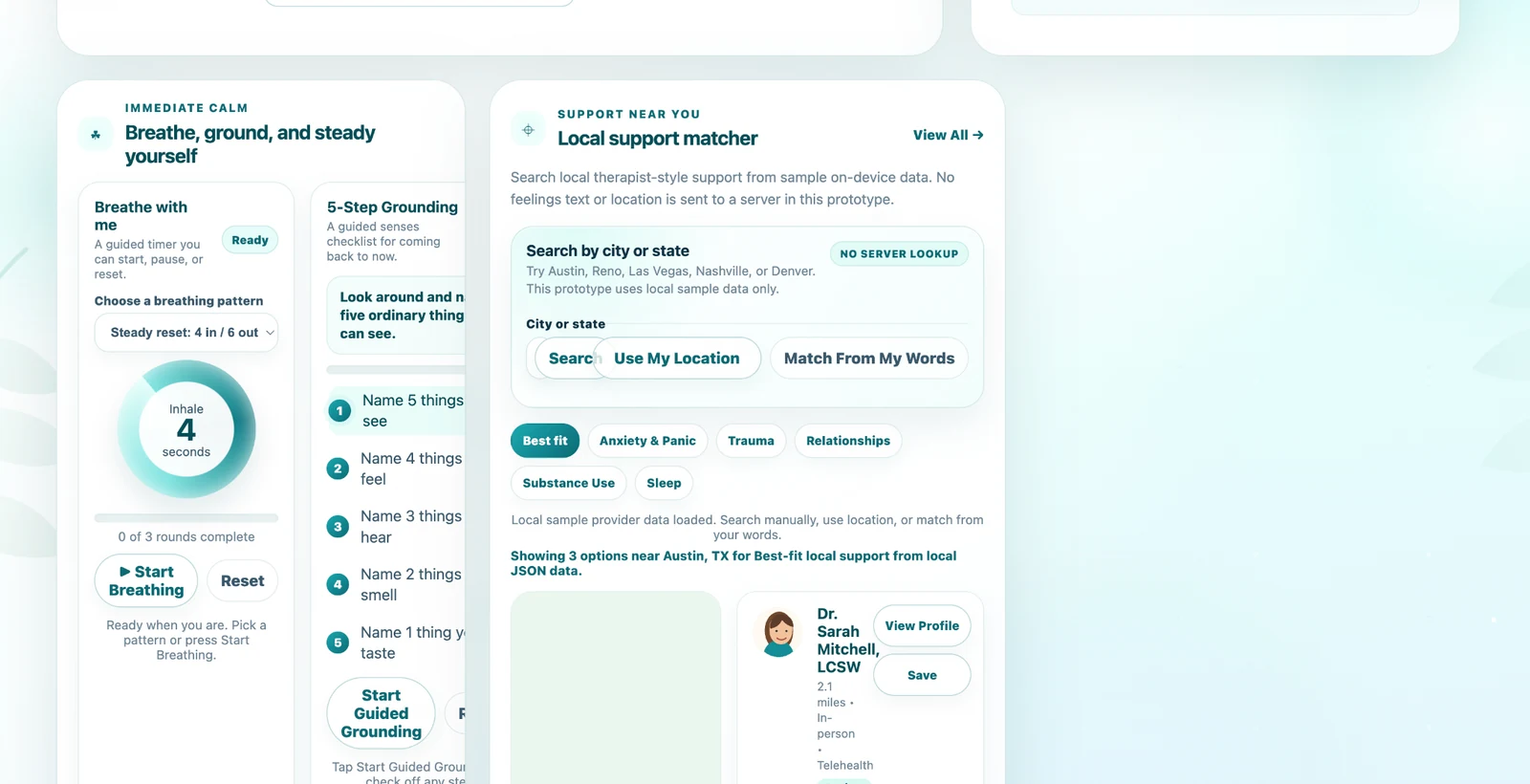
TherapyLink.AI product prototype overview with breathing tools, grounding, and a local support matcher
Real product view The product is shown before the deeper technical story.
  1. 01
    Private reflectionKeep sensitive context close to the person and disclose only what is necessary.
  2. 02
    Visible limitsSeparate supportive guidance from diagnosis, emergency response, and professional care.
  3. 03
    Consent-bound next stepsRequire explicit permission before sharing, escalating, or changing workflow state.
MARKETING

The complete audience, competitive, and positioning story begins here.

A trust-centered AI web application that turns a sensitive question into a private, understandable guided workflow. It uses bounded mini-apps, local intent routing, explicit uncertainty, safety checks, and human-handoff boundaries without presenting software as a therapist or medical authority.

Why it stands apart: Many wellness chatbots maximize open-ended conversation and blur responsibility. TherapyLink.AI narrows each interaction to consented tools, keeps privacy and escalation visible, and uses deterministic safety boundaries so helpful guidance cannot silently become diagnosis or treatment.

PRODUCT SIGNALSWhy people notice and remember the product
  1. 01Intent-routed mini-apps
  2. 02Local summarization
  3. 03Trust-centric product design
  4. 04More trustworthy UX
  5. 05Better privacy posture
  6. 06Stronger human handoff design
BUSINESS / EXECUTIVE

Turn a sensitive question into a private, understandable next step without pretending software is a therapist or medical authority.

It makes the strongest case that AI products can be humane, privacy-conscious, and operationally serious.

Executive case: Many wellness chatbots maximize open-ended conversation and blur responsibility. TherapyLink.AI narrows each interaction to consented tools, keeps privacy and escalation visible, and uses deterministic safety boundaries so helpful guidance cannot silently become diagnosis or treatment.

VALUE AND PROOFWhat a leader can defend, measure, or operationalize
  1. 01More trustworthy UX
  2. 02Better privacy posture
  3. 03Stronger human handoff design
ARCHITECTURE

Edge AI is treated as the private first pass: local models summarize reflections, detect likely themes, route the user toward appropriate guided mini-app flows, and reduce cloud exposure for sensitive early-stage user data.

I designed TherapyLink.AI as an intent-routed web product rather than an open-ended therapy bot. It uses privacy-first local processing for early summarization and theme detection, then guides the user into bounded reflection, education, safety-check, or handoff flows with clear limits around what the software can and cannot do.

Authority boundary: The OverLift method keeps intent, consent, privacy, uncertainty, safety checks, and human handoff boundaries explicit. Local models can help organize a reflection and route it toward an appropriate guided tool, while deterministic rules decide what the product may show, when it must stop, and when a person should be directed toward qualified human support.

  1. 01

    Begin with the user's question and preserve consent and privacy choices.

  2. 02

    Use a bounded local-first pass to summarize the request and identify likely intent without making a diagnosis.

  3. 03

    Route the user to a specific reflection, education, safety-check, or human-handoff flow.

  4. 04

    Show uncertainty and product limits instead of turning a guess into an authoritative answer.

  5. 05

    Stop or escalate when a rule says the software should not continue on its own.

  6. 06

    Keep the interaction understandable so the user can see what the product did and choose the next step.

ENGINEERING

The project is presented like a calm, premium service experience: direct language, high-trust surfaces, and visual maturity instead of loud AI branding.

I shaped the product concept, trust model, intent-routing architecture, local-first privacy direction, guided mini-app structure, safety and handoff boundaries, and the visual language needed for a sensitive product to feel calm, direct, and operationally responsible.

Technology stackASP.NET Core, AI workflows, intent routing, product systems
IMPLEMENTED ENGINEERINGWorking systems and verified boundaries
  1. 01Sensitive data handled with privacy-first flows
  2. 02Query routing into guided workflows
  3. 03AI framed as assistance, not replacement
OVERLIFT METHOD

The OverLift method keeps intent, consent, privacy, uncertainty, safety checks, and human handoff boundaries explicit. Local models can help organize a reflection and route it toward an appropriate guided tool, while deterministic rules decide what the product may show, when it must stop, and when a person should be directed toward qualified human support.

  1. T0
    Exact baseline

    Define the authoritative result before adding acceleration, semantics, or agents.

  2. T1
    Measured evidence

    Instrument state, latency, quality, and failure so improvement is observable.

  3. T2
    Bounded ownership

    Move expensive or high-frequency work behind clear worker and memory boundaries.

  4. T3
    Deterministic transport

    Version messages, snapshots, identities, deadlines, and replay inputs.

  5. T4
    Semantic assistance

    Let local retrieval and models propose meaning only inside admitted evidence.

  6. T5
    Candidate paths

    Compare several allowed next actions with explicit risk, cost, fit, and uncertainty.

  7. T6
    Shadow verification

    Challenge the production route without giving the challenger authority.

  8. T7
    Governed production

    Promote only measured, replayable paths with fallback and operational receipts.

  9. Tier-S
    Experimental challenger

    Run advanced evaluators in shadow, compare them with the control, and graduate only repeatable gains.

CATS

Context-Aware Tier Selection

CATS chooses the least risky qualified execution tier for the current evidence, device, latency, authority, and failure context. The product does not run its most advanced path merely because it exists.

SEMANTIC BRIDGE

Meaning becomes typed product state

The Semantic Bridge translates human goals, documents, events, or observations into explicit entities, evidence, uncertainty, tools, and permissions. It preserves missing and contradictory information instead of smoothing it away.

DETERMINISM

One official result, evidence, and replay path

Models may retrieve, classify, compare, or propose. Exact software remains the authority over admitted facts, legal actions, state transitions, approval, execution, and the receipt that proves what happened.

Read the complete OverLift Method Explore OverLift security Run the OverLift demonstration Explore the Agentic AI Glossary
BROWSER-BASED AGENTIC AI SYSTEM

TherapyLink.AI is one vertical proof inside a wider browser-based system. The point is not to force every product through identical technology; it is to apply the right combination of local intelligence, retrieval, sandboxing, explicit capabilities, agents, deterministic authority, and proof without turning any of them into marketing checkboxes.

CAPABILITY PROOFWhat is active, shared, bounded, or authoritative in this product
  1. 01 ACTIVE IN PRODUCT

    Browser-native product surface

    The working interface, local execution path, or browser-class runtime makes the system inspectable, portable, and available without hiding the product behind an API demo.

  2. 02 ACTIVE PRIVACY BOUNDARY

    Privacy and minimum disclosure

    Sensitive context is processed locally, same-origin, or offline where the product benefits. Any provider-bound step is intentionally scoped instead of receiving the complete product history.

  3. 03 ACTIVE IN PRODUCT

    Narrow agents and typed tools

    Agents receive bounded context, explicit capabilities, deadlines, and typed tools. They may retrieve, classify, compare, explain, or propose; they may not silently expand their own authority.

  4. 04 SHARED WHEN NEEDED

    RAG and vector evidence

    The shared platform can add local vector retrieval when semantic memory improves the product. It does not force a vector database into a workflow where exact state is already the better authority.

  5. 05 SHARED AUTHORITY PATH

    C17 / WebAssembly kernel

    This product keeps an explicit deterministic authority boundary and can use the shared C17/WebAssembly kernel where browser-local validation, exact replay, or protected state transitions are required.

  6. 06 ACTIVE SECURITY BOUNDARY

    Security and least privilege

    Private prompts, consent state, safety signals, and guided workflows remain bounded. A model may classify or explain, but it cannot diagnose, escalate, contact a service, disclose history, or change care state without explicit policy, consent, and human authority.

  7. 07 ACTIVE IN PRODUCT

    Receipts, replay, and evaluation

    Important inputs, candidate paths, approvals, state changes, and outcomes remain inspectable through receipts, traces, reversible operations, replay, or exact comparisons appropriate to the product.

Evidence-bound RAG Source and identity checks Narrow agents Typed tools Sandboxed execution Explicit capability allowlists Least privilege Local-first privacy Minimum disclosure Human approval Abstention and fail-closed paths Receipts, replay, and evaluation
What this proves The product structure makes each route visible: the user's intent, the selected guided tool, the privacy boundary, the uncertainty or safety condition, and the available human handoff. The value comes from a controlled experience rather than a hidden prompt producing an unrestricted answer.