OFFLINE QUANTITATIVE RESEARCH · BUILT WITH OVERLIFT

Saros.ai

Research the market as it was—not as hindsight makes it look.

Saros is an offline research and decision workstation for analysts who need to combine markets, filings, macro data, news, and prior reasoning without losing time context. It keeps source facts, learned interpretation, disagreement, and thesis state separate so a conclusion can be challenged and reproduced later.

See the research workflow Follow the product story
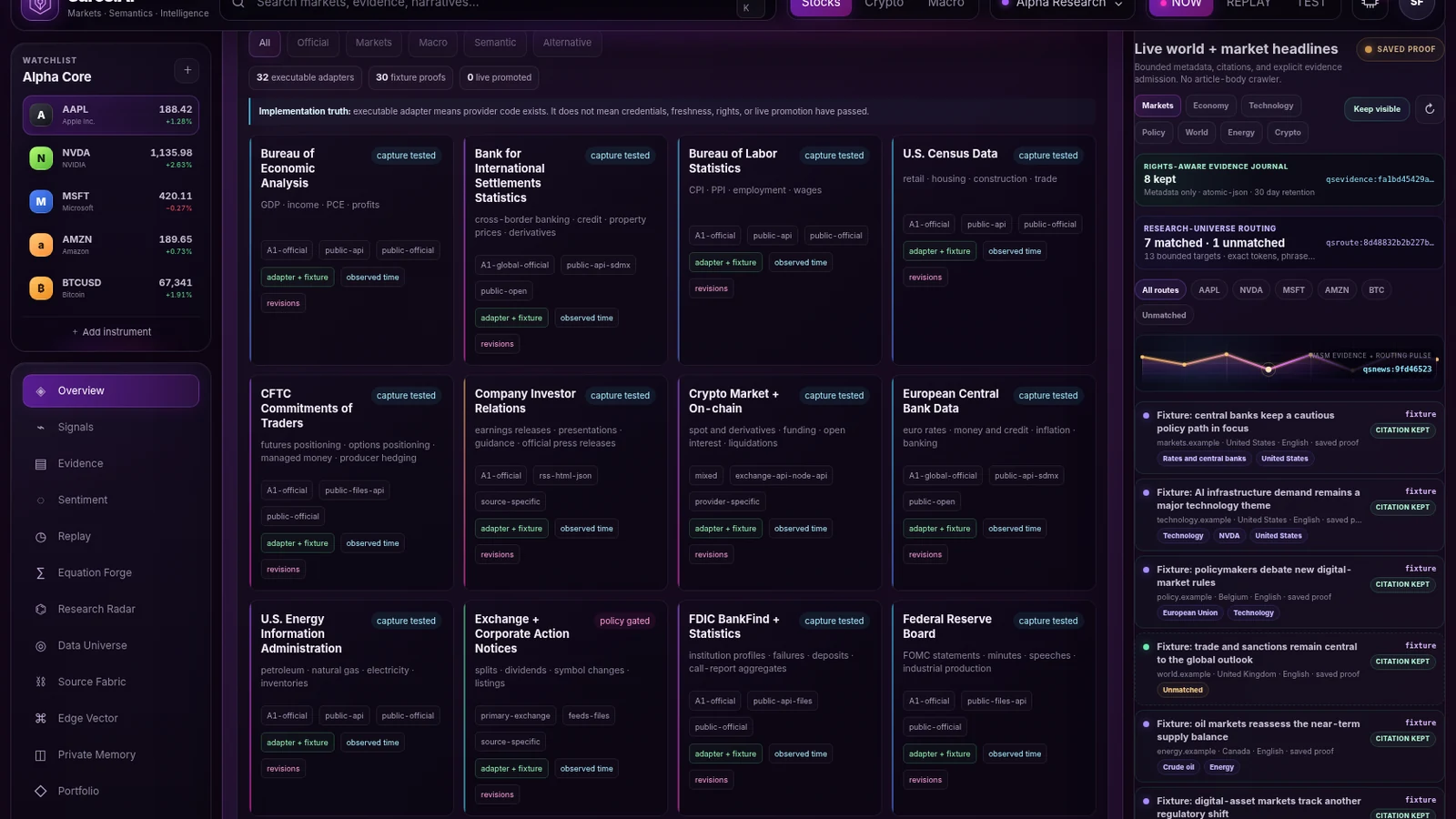
Saros.ai source registry with governed market, macroeconomic, and evidence providers
Real product view The product is shown before the deeper technical story.
  1. 01
    Point-in-time truthPreserve what was actually knowable when the decision was made.
  2. 02
    Visible disagreementShow conflicting sources, excluded evidence, uncertainty, and changing interpretation.
  3. 03
    Reproducible conclusionsReplay the evidence, calculations, authority, and thesis path later.
MARKETING

Make the useful difference easy to understand and remember.

The complete audience, competitive, and positioning story begins here.

A reproducible market-intelligence workstation that reconstructs what was knowable at a chosen point in time, connects price behavior to governed evidence, tests a thesis, and preserves the assumptions, calculations, sources, and receipt behind the result.

Why it stands apart: Most market tools mix current knowledge with historical analysis and make hindsight leakage hard to detect. Saros freezes the as-of evidence, keeps semantic organization separate from deterministic math, and makes a thesis replayable so later conclusions can be compared honestly.

PRODUCT SIGNALSWhy people notice and remember the product
  1. 01Reproducible market reasoning
  2. 02Bitemporal evidence
  3. 03Deterministic econometrics
  4. 04More defensible research
  5. 05Faster thesis testing
  6. 06Clearer provider and evidence accountability
BUSINESS / EXECUTIVE

Give analysts an offline, replayable process for thesis formation, risk, and evidence review.

Research markets with the evidence, assumptions, calculations, and point in time preserved together.

The business value is research that can be reproduced, challenged, updated, and reviewed without silently changing its historical basis.

Executive case: Most market tools mix current knowledge with historical analysis and make hindsight leakage hard to detect. Saros freezes the as-of evidence, keeps semantic organization separate from deterministic math, and makes a thesis replayable so later conclusions can be compared honestly.

VALUE AND PROOFWhat a leader can defend, measure, or operationalize
  1. 01More defensible research
  2. 02Faster thesis testing
  3. 03Clearer provider and evidence accountability
  4. 04As-of research workflows using captured and labeled fixtures
  5. 05Source rights, citation preservation, provider disagreement, and revision visibility
  6. 06Market charting connected to evidence, scenarios, and deterministic tools
ARCHITECTURE

Point-in-time market evidence, local semantic retrieval, typed calculations, and thesis state are kept distinct.

Embeddings, classifiers, hybrid retrieval, reranking, and model-assisted reasoning organize filings, macro releases, news, events, and research notes. Deterministic C17/WebAssembly functions own chronology, feature construction, event studies, regressions, risk, scenarios, state hashes, and tool policies.

I built Saros.ai as an offline-first quantitative research workstation. It combines governed provider adapters, as-of evidence, local vector memory, market and macro research surfaces, deterministic econometrics, scenario tools, replay, and portable receipts that preserve the sources and assumptions behind a result.

Authority boundary: The OverLift method freezes the as-of evidence, separates semantic organization from deterministic math, explores scenarios without rewriting history, and saves a receipt that makes the thesis reproducible. A later result can be compared honestly with what was knowable earlier.

  1. 01

    Choose the instrument, research question, and exact point in time.

  2. 02

    Gather permitted market, filing, macro, news, and research evidence.

  3. 03

    Preserve source identity, revisions, rights, and the time each fact became knowable.

  4. 04

    Use semantic retrieval to organize the evidence without owning the math.

  5. 05

    Run deterministic calculations, scenarios, and comparisons against the frozen state.

  6. 06

    Save a receipt so another person can replay or challenge the thesis.

ENGINEERING

Offline providers, deterministic quant math, local models, vector search, receipts, and replay.

The product is designed as a market research time machine: a polished browser workstation, provider-neutral data contracts, bitemporal evidence, local vector memory, deterministic computation, and receipts that show exactly which sources and assumptions produced the result.

I designed the offline-first product, provider-neutral contracts, bitemporal evidence model, deterministic quantitative boundary, local semantic memory, workstation interface, replay and receipt system, and Azure deployment path.

Technology stack.NET 10, C17/WebAssembly, PostgreSQL, pgvector, hybrid RAG, ONNX Runtime Web, deterministic econometrics
IMPLEMENTED ENGINEERINGWorking systems and verified boundaries
  1. 01Browser research workstation, governed source registry, replay, and private research memory
  2. 02Provider-neutral evidence contracts, local vector surfaces, and deterministic analytical functions
  3. 03Portable state and evidence receipts
  4. 04As-of market replay tied to one evidence clock
  5. 05Hybrid RAG and local vector memory for source-grounded research
  6. 06Deterministic quantitative functions with portable receipts
OVERLIFT METHOD

How OverLift makes Saros.ai adaptive without surrendering authority.

The OverLift method freezes the as-of evidence, separates semantic organization from deterministic math, explores scenarios without rewriting history, and saves a receipt that makes the thesis reproducible. A later result can be compared honestly with what was knowable earlier.

  1. T0
    Exact baseline

    Define the authoritative result before adding acceleration, semantics, or agents.

  2. T1
    Measured evidence

    Instrument state, latency, quality, and failure so improvement is observable.

  3. T2
    Bounded ownership

    Move expensive or high-frequency work behind clear worker and memory boundaries.

  4. T3
    Deterministic transport

    Version messages, snapshots, identities, deadlines, and replay inputs.

  5. T4
    Semantic assistance

    Let local retrieval and models propose meaning only inside admitted evidence.

  6. T5
    Candidate paths

    Compare several allowed next actions with explicit risk, cost, fit, and uncertainty.

  7. T6
    Shadow verification

    Challenge the production route without giving the challenger authority.

  8. T7
    Governed production

    Promote only measured, replayable paths with fallback and operational receipts.

  9. Tier-S
    Experimental challenger

    Run advanced evaluators in shadow, compare them with the control, and graduate only repeatable gains.

CATS

Context-Aware Tier Selection

CATS chooses the least risky qualified execution tier for the current evidence, device, latency, authority, and failure context. The product does not run its most advanced path merely because it exists.

SEMANTIC BRIDGE

Meaning becomes typed product state

The Semantic Bridge translates human goals, documents, events, or observations into explicit entities, evidence, uncertainty, tools, and permissions. It preserves missing and contradictory information instead of smoothing it away.

DETERMINISM

One official result, evidence, and replay path

Models may retrieve, classify, compare, or propose. Exact software remains the authority over admitted facts, legal actions, state transitions, approval, execution, and the receipt that proves what happened.

Read the complete OverLift Method Explore OverLift security Run the OverLift demonstration Explore the Agentic AI Glossary
BROWSER-BASED AGENTIC AI SYSTEM

The offline quantitative-agent workstation in the Browser-Based Agentic AI System family.

Saros.ai is one vertical proof inside a wider browser-based system. The point is not to force every product through identical technology; it is to apply the right combination of local intelligence, retrieval, sandboxing, explicit capabilities, agents, deterministic authority, and proof without turning any of them into marketing checkboxes.

CAPABILITY PROOFWhat is active, shared, bounded, or authoritative in this product
  1. 01 ACTIVE IN PRODUCT

    Browser-native product surface

    The working interface, local execution path, or browser-class runtime makes the system inspectable, portable, and available without hiding the product behind an API demo.

  2. 02 ACTIVE PRIVACY BOUNDARY

    Privacy and minimum disclosure

    Sensitive context is processed locally, same-origin, or offline where the product benefits. Any provider-bound step is intentionally scoped instead of receiving the complete product history.

  3. 03 BOUNDED PLATFORM ROLE

    Narrow agents and typed tools

    This vertical contributes deterministic product state to the shared agent fabric. Any future agent remains narrow, permission-bound, and unable to invent executable capabilities.

  4. 04 ACTIVE IN PRODUCT

    RAG and vector evidence

    Local or governed retrieval builds an evidence set before reasoning. Vector similarity proposes useful context, while source identity, freshness, access, and deterministic admission decide what the product may trust.

  5. 05 ACTIVE IN PRODUCT

    C17 / WebAssembly kernel

    A WebAssembly authority path keeps exact state, validation, and replay separate from probabilistic assistance. Faster or more creative layers cannot redefine the official result.

  6. 06 ACTIVE SECURITY BOUNDARY

    Security and least privilege

    Each source adapter receives a governed data contract rather than ambient filesystem, credential, portfolio, or network access. Rights, point-in-time boundaries, calculations, thesis transitions, exclusions, and replay stay under deterministic local authority.

  7. 07 ACTIVE IN PRODUCT

    Receipts, replay, and evaluation

    Important inputs, candidate paths, approvals, state changes, and outcomes remain inspectable through receipts, traces, reversible operations, replay, or exact comparisons appropriate to the product.

Evidence-bound RAG Source and identity checks Narrow agents Typed tools Sandboxed execution Explicit capability allowlists Least privilege Local-first privacy Minimum disclosure Human approval Abstention and fail-closed paths Receipts, replay, and evaluation
What this proves The source registry makes each provider mode, permission, and evidence boundary visible. The workstation brings charting, evidence intake, local vectors, private memory, replay, and quantitative tools into one inspectable product.
PRODUCT PROOF

These are real project views from the actual work—not generic stock illustration. They connect the product story to an interface, workflow, or result a visitor can inspect.