BROWSER-BASED AGENTIC AI SYSTEM · FLAGSHIP OVERLIFT PRODUCT

OverLift

Let AI explore. Keep truth exact.

OverLift turns a difficult operational question into visible evidence, several defensible paths, an approval-aware decision, and a receipt people can inspect. It is for teams that want the speed of agentic AI without handing a model control of facts, permissions, or official state.

See why OverLift is different Follow the product story
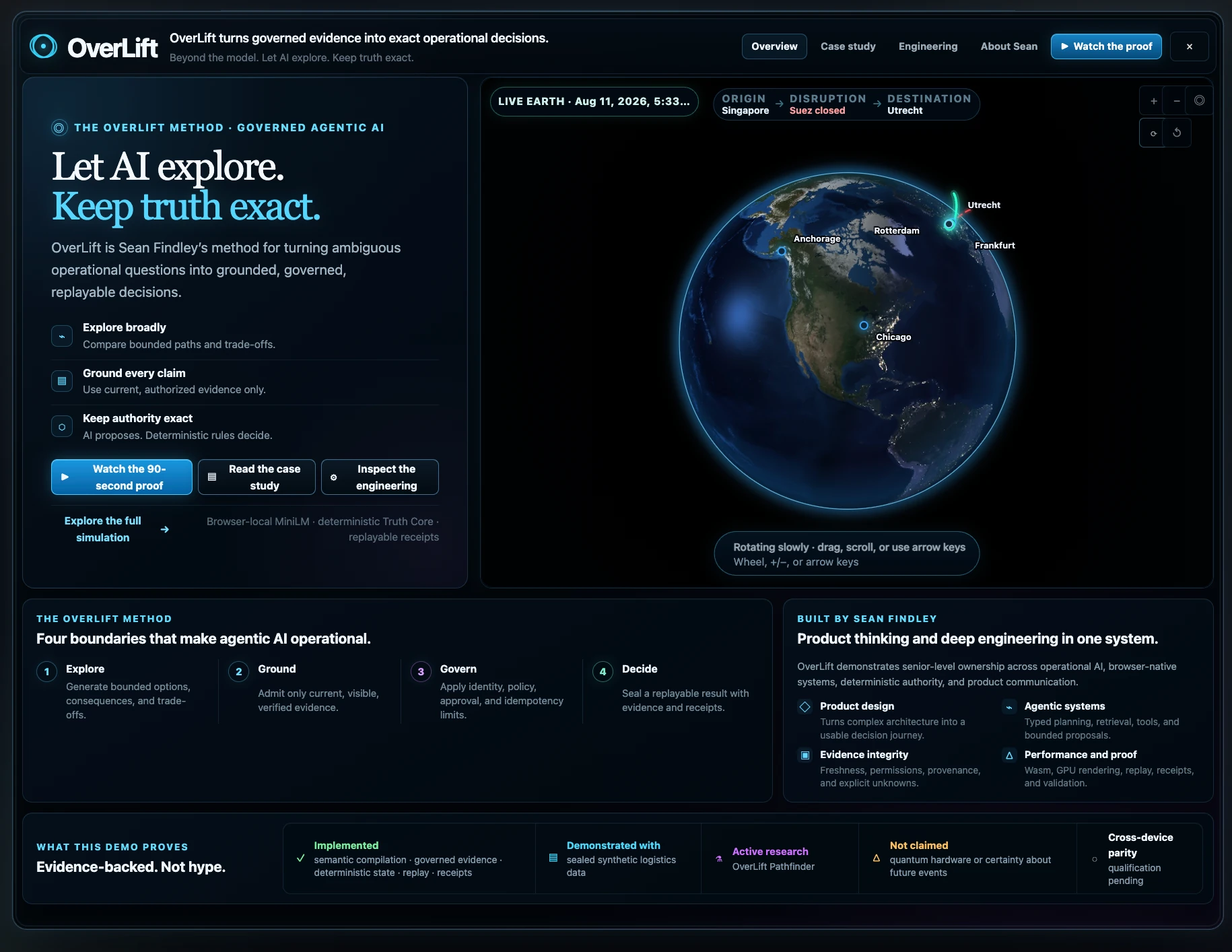
OverLift interactive browser simulator with a globe, guided proof, Evidence Fabric, authority boundary, and Decision Receipt
Real product view The product is shown before the deeper technical story.
  1. 01
    Visible evidenceSee what was admitted, rejected, missing, or uncertain.
  2. 02
    Several defensible pathsCompare alternatives instead of receiving one opaque answer.
  3. 03
    A provable outcomePreserve the approval, state change, verification, and receipt.
MARKETING

Make the useful difference easy to understand and remember.

The complete audience, competitive, and positioning story begins here.

An interactive governed-AI simulator that turns a natural-language logistics question into admitted evidence, typed state, multiple recovery paths, an approval-aware decision, and a replayable receipt. It is designed for leaders and engineers who need to see exactly where AI helps and where exact software retains control.

Why it stands apart: Unlike an opaque copilot that jumps from prompt to answer, OverLift exposes evidence, alternatives, authority, execution, and replay in one working product. Its C17/WebAssembly Truth Core can reject a persuasive AI proposal that does not satisfy facts, policy, permission, or current state.

PRODUCT SIGNALSWhy people notice and remember the product
  1. 01Understand the question
  2. 02Show the evidence
  3. 03Keep authority exact
  4. 04Clearer AI decisions
  5. 05Safer automation
  6. 06Results people can inspect and replay
BUSINESS / EXECUTIVE

Turn AI ambition into accountable decisions, approval boundaries, and replayable proof.

Turn a hard question into a governed decision that people can inspect, replay, and trust.

It makes agentic AI useful for real work without turning a model into an invisible boss over business facts and actions.

Executive case: Unlike an opaque copilot that jumps from prompt to answer, OverLift exposes evidence, alternatives, authority, execution, and replay in one working product. Its C17/WebAssembly Truth Core can reject a persuasive AI proposal that does not satisfy facts, policy, permission, or current state.

VALUE AND PROOFWhat a leader can defend, measure, or operationalize
  1. 01Clearer AI decisions
  2. 02Safer automation
  3. 03Results people can inspect and replay
  4. 04Synthetic logistics incident with local RAG and multiple recovery paths
  5. 05Human approval boundary and post-action verification
  6. 06Deterministic replay from the same admitted state
ARCHITECTURE

A semantic planning layer above an exact WebAssembly authority core.

The AI helpers may search, compare, explain, and propose. They cannot rewrite admitted facts, raise their own authority, or directly commit a consequential change. The trusted kernel checks the plan before anything becomes official.

I designed and built an interactive browser product around the OverLift method. It combines local retrieval, visible evidence, typed state, multiple candidate plans, policy and approval checks, a C17/WebAssembly Truth Core, Decision Receipts, rewind, and replay. The AI helpers are useful, but the exact kernel owns what becomes official.

Authority boundary: OverLift applies the method end to end: preserve the question, admit the right evidence, translate it into typed state, compare candidate paths, enforce policy and approval, let exact software commit the result, and seal a receipt. The AI can be inventive without becoming the owner of truth.

  1. 01

    Ask the question in ordinary language and preserve the exact request.

  2. 02

    Retrieve permitted evidence and show what was admitted, rejected, missing, or uncertain.

  3. 03

    Convert that evidence into typed state instead of leaving it as an unstructured conversation.

  4. 04

    Compare several possible plans and explain the tradeoffs.

  5. 05

    Apply policy, permission, cost, and human approval rules before execution.

  6. 06

    Let exact software commit the allowed result and seal a receipt for replay.

ENGINEERING

Evidence, typed state, bounded tools, deterministic execution, and receipts.

OverLift turns a complicated AI architecture into something a visitor can touch. The globe, evidence panels, route explorer, approval boundary, and receipt all show where intelligence helps and where exact authority begins.

I created the product architecture, authority boundary, browser experience, synthetic logistics world, Semantic Bridge, deterministic kernel contract, proof workflow, and the plain-language story that connects the engineering to a business problem.

Technology stackBrowser-native agents, local RAG, vector search, C17/WebAssembly Truth Core, deterministic replay, Decision Receipts
IMPLEMENTED ENGINEERINGWorking systems and verified boundaries
  1. 01Browser-based guided and open simulator
  2. 02Evidence admission, typed state, governance, Decision Receipts, rewind, and replay
  3. 03C17/WebAssembly Truth Core separated from agent proposals
  4. 04Guided and open simulator modes with semantic questions
  5. 05Evidence, alternatives, approval limits, execution, receipts, rewind, and replay
  6. 06A browser-based WebAssembly authority core that remains separate from the agents
OVERLIFT METHOD

How OverLift makes OverLift adaptive without surrendering authority.

OverLift applies the method end to end: preserve the question, admit the right evidence, translate it into typed state, compare candidate paths, enforce policy and approval, let exact software commit the result, and seal a receipt. The AI can be inventive without becoming the owner of truth.

  1. T0
    Exact baseline

    Define the authoritative result before adding acceleration, semantics, or agents.

  2. T1
    Measured evidence

    Instrument state, latency, quality, and failure so improvement is observable.

  3. T2
    Bounded ownership

    Move expensive or high-frequency work behind clear worker and memory boundaries.

  4. T3
    Deterministic transport

    Version messages, snapshots, identities, deadlines, and replay inputs.

  5. T4
    Semantic assistance

    Let local retrieval and models propose meaning only inside admitted evidence.

  6. T5
    Candidate paths

    Compare several allowed next actions with explicit risk, cost, fit, and uncertainty.

  7. T6
    Shadow verification

    Challenge the production route without giving the challenger authority.

  8. T7
    Governed production

    Promote only measured, replayable paths with fallback and operational receipts.

  9. Tier-S
    Experimental challenger

    Run advanced evaluators in shadow, compare them with the control, and graduate only repeatable gains.

CATS

Context-Aware Tier Selection

CATS chooses the least risky qualified execution tier for the current evidence, device, latency, authority, and failure context. The product does not run its most advanced path merely because it exists.

SEMANTIC BRIDGE

Meaning becomes typed product state

The Semantic Bridge translates human goals, documents, events, or observations into explicit entities, evidence, uncertainty, tools, and permissions. It preserves missing and contradictory information instead of smoothing it away.

DETERMINISM

One official result, evidence, and replay path

Models may retrieve, classify, compare, or propose. Exact software remains the authority over admitted facts, legal actions, state transitions, approval, execution, and the receipt that proves what happened.

Read the complete OverLift Method Explore OverLift security Run the OverLift demonstration Explore the Agentic AI Glossary
BROWSER-BASED AGENTIC AI SYSTEM

The reference architecture for the wider Browser-Based Agentic AI System.

OverLift is one vertical proof inside a wider browser-based system. The point is not to force every product through identical technology; it is to apply the right combination of local intelligence, retrieval, sandboxing, explicit capabilities, agents, deterministic authority, and proof without turning any of them into marketing checkboxes.

CAPABILITY PROOFWhat is active, shared, bounded, or authoritative in this product
  1. 01 ACTIVE IN PRODUCT

    Browser-native product surface

    The working interface, local execution path, or browser-class runtime makes the system inspectable, portable, and available without hiding the product behind an API demo.

  2. 02 ACTIVE PRIVACY BOUNDARY

    Privacy and minimum disclosure

    Sensitive context is processed locally, same-origin, or offline where the product benefits. Any provider-bound step is intentionally scoped instead of receiving the complete product history.

  3. 03 ACTIVE IN PRODUCT

    Narrow agents and typed tools

    Agents receive bounded context, explicit capabilities, deadlines, and typed tools. They may retrieve, classify, compare, explain, or propose; they may not silently expand their own authority.

  4. 04 ACTIVE IN PRODUCT

    RAG and vector evidence

    Local or governed retrieval builds an evidence set before reasoning. Vector similarity proposes useful context, while source identity, freshness, access, and deterministic admission decide what the product may trust.

  5. 05 ACTIVE IN PRODUCT

    C17 / WebAssembly kernel

    A WebAssembly authority path keeps exact state, validation, and replay separate from probabilistic assistance. Faster or more creative layers cannot redefine the official result.

  6. 06 ACTIVE SECURITY BOUNDARY

    Security and least privilege

    Browser workers and WebAssembly narrow the execution surface; explicit imports and typed tools expose only the capability required for the current step. Identity, policy, approvals, canonical state, exact execution, verification, receipts, and replay remain in deterministic authority code.

  7. 07 ACTIVE IN PRODUCT

    Receipts, replay, and evaluation

    Important inputs, candidate paths, approvals, state changes, and outcomes remain inspectable through receipts, traces, reversible operations, replay, or exact comparisons appropriate to the product.

Evidence-bound RAG Source and identity checks Narrow agents Typed tools Sandboxed execution Explicit capability allowlists Least privilege Local-first privacy Minimum disclosure Human approval Abstention and fail-closed paths Receipts, replay, and evaluation
What this proves The live simulator exposes the question, admitted and rejected evidence, interpreted meaning, route candidates, approval boundary, exact state, and final receipt. A visitor can rewind and replay the same evidence instead of accepting a hidden model answer.