BROWSER-BASED OPERATIONS INTELLIGENCE · BUILT WITH OVERLIFT

OverLift Logistics

Rescue the shipment before the SLA breaks.

OverLift Logistics turns delays, inventory, customer terms, courier limits, cost, and deadlines into one understandable recovery workflow. Operations teams can see the risk, compare viable routes, understand the tradeoffs, and prepare the next action without surrendering dispatch or approval authority.

See the recovery workflow Follow the product story
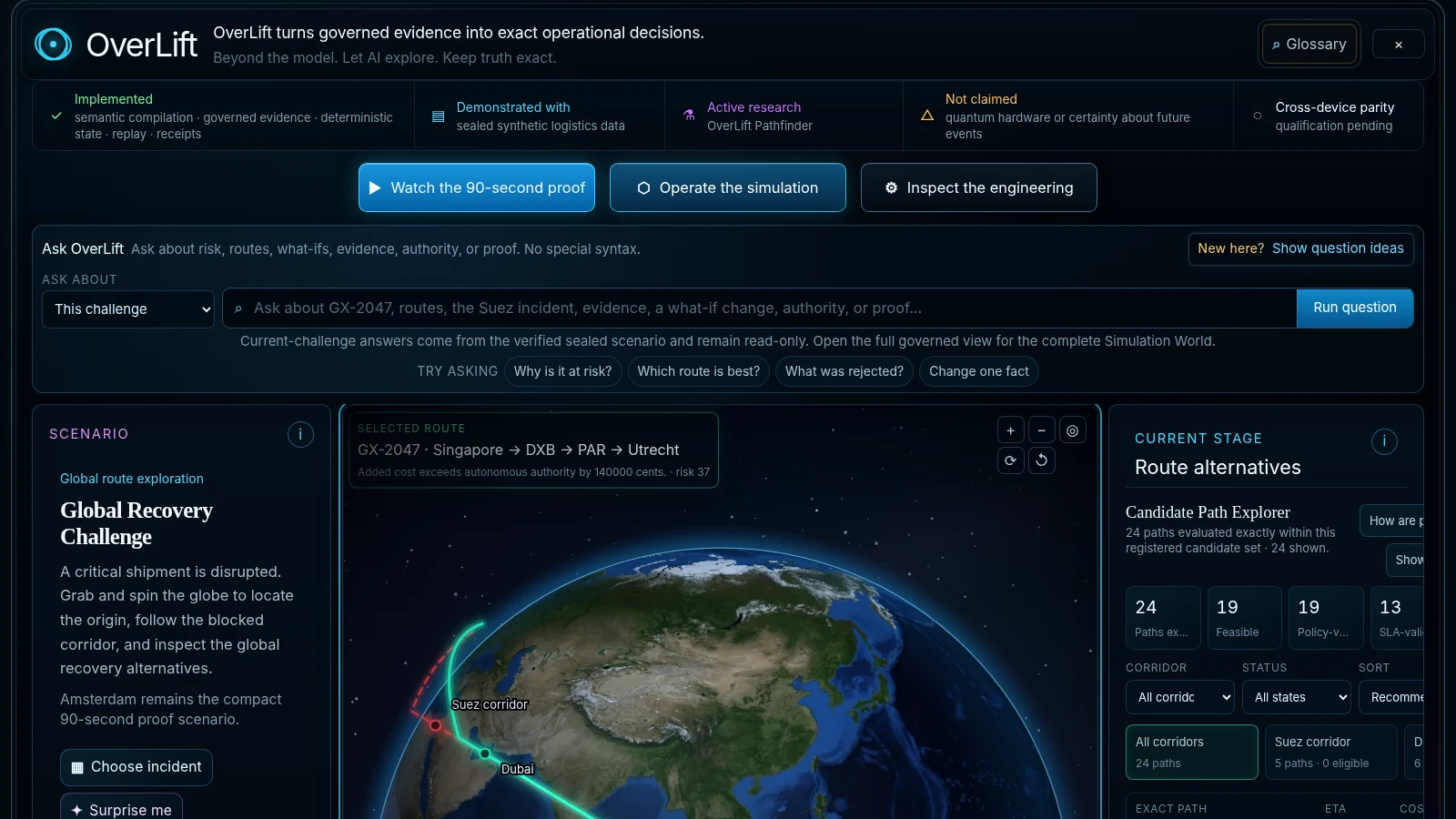
OverLift Logistics global route explorer comparing evidence-backed recovery paths
Real product view The product is shown before the deeper technical story.
  1. 01
    Situation-awareBring shipment, inventory, contract, telemetry, and deadline evidence into one view.
  2. 02
    Defensible optionsCompare recovery paths with visible cost, risk, fit, and exclusions.
  3. 03
    Approval-safePrepare action without bypassing identity, policy, deduplication, or review.
MARKETING

Make the useful difference easy to understand and remember.

The complete audience, competitive, and positioning story begins here.

An SLA exception-intelligence product for shipments, service parts, inventory, couriers, and recovery operations. It assembles fragmented operational evidence, explains why an order is at risk, compares viable recovery routes, and stops at the correct human-approval boundary.

Why it stands apart: Most logistics assistants summarize the problem; OverLift Logistics connects time-aware evidence to typed tools, deterministic validation, and post-action receipts. That makes every recommended route inspectable, permission-bound, and reproducible instead of merely plausible.

PRODUCT SIGNALSWhy people notice and remember the product
  1. 01SLA exception intelligence
  2. 02Governed agent actions
  3. 03Bitemporal operational truth
  4. 04Faster exception resolution
  5. 05Stronger SLA protection
  6. 06Auditable operational decisions
BUSINESS / EXECUTIVE

Protect service levels while making authority, cost, risk, and accountability explicit.

Rescue an at-risk shipment by showing the facts, comparing recovery routes, and stopping at the correct approval boundary.

The business value is faster exception response, clearer accountability, stronger SLA protection, and fewer operational decisions based on incomplete or stale information.

Executive case: Most logistics assistants summarize the problem; OverLift Logistics connects time-aware evidence to typed tools, deterministic validation, and post-action receipts. That makes every recommended route inspectable, permission-bound, and reproducible instead of merely plausible.

VALUE AND PROOFWhat a leader can defend, measure, or operationalize
  1. 01Faster exception resolution
  2. 02Stronger SLA protection
  3. 03Auditable operational decisions
  4. 04Amsterdam facility outage and evidence-backed reroute comparison
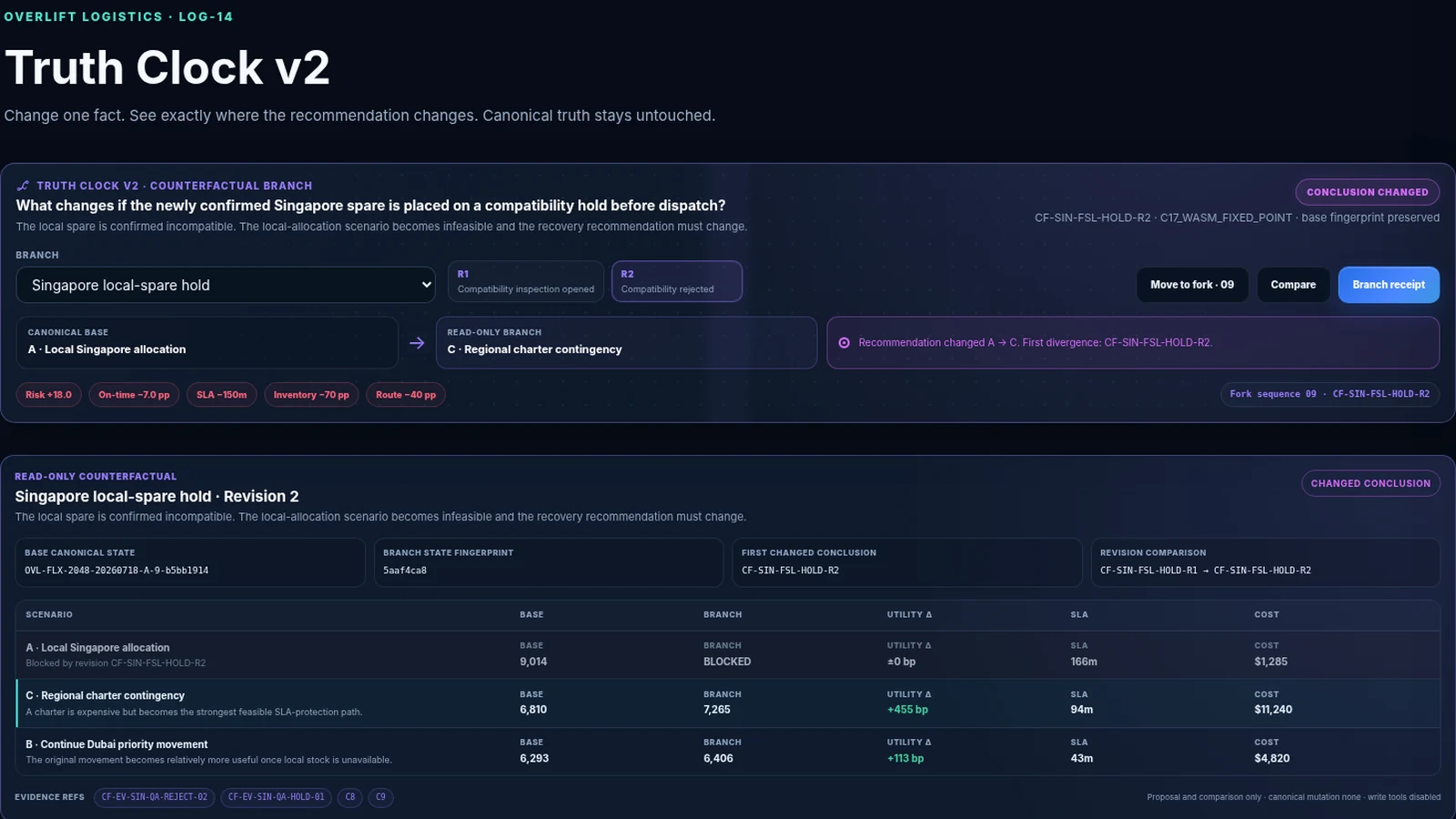
  5. 05Read-only counterfactual branches that preserve canonical truth
  6. 06Stale, restricted, and contradictory evidence handling in the browser
ARCHITECTURE

Time-aware logistics evidence becomes typed state before any recovery route is considered.

RAG and agent orchestration interpret the exception, assemble evidence, and propose typed recovery actions. Deterministic code validates identity, permissions, inventory state, SLA rules, costs, and preconditions before execution. A post-action verifier confirms the result and writes a causality receipt.

I built OverLift Logistics as a synthetic but working operations laboratory. It includes a local evidence corpus, hybrid retrieval, route and inventory candidates, a typed tool boundary, counterfactual branches, approval checks, a Truth Clock, and receipts that preserve why one recovery path was preferred over another.

Authority boundary: The OverLift method turns scattered shipment facts into one time-aware state, compares several recovery paths, rejects routes that break inventory, SLA, cost, or authority rules, and records why the approved plan won. Operations teams get speed without losing control.

  1. 01

    Start with the shipment, service promise, and current incident.

  2. 02

    Retrieve shipment, inventory, facility, courier, and procedure evidence.

  3. 03

    Build one typed picture of what is known, missing, stale, or contradictory.

  4. 04

    Compare feasible recovery routes with cost, time, inventory, and risk visible.

  5. 05

    Require the correct approval before a consequential tool can run.

  6. 06

    Verify the outcome and preserve the evidence and decision in a receipt.

ENGINEERING

Hybrid retrieval, narrow tools, deterministic validation, and post-action verification.

OverLift Logistics turns agentic AI into an operations product rather than a general chatbot: bounded context, governed retrieval, narrow tools, measurable route scoring, explicit uncertainty, human authorization, and replayable decisions.

I designed the synthetic logistics company, operational data model, evidence and security rules, agent and tool boundary, deterministic scoring path, counterfactual workflow, browser interface, and the proof language used to explain the system.

Technology stackASP.NET Core, Azure, hybrid RAG, vector search, bitemporal events, LangGraph/LangChain patterns, typed tools, C17/WebAssembly, OpenTelemetry
IMPLEMENTED ENGINEERINGWorking systems and verified boundaries
  1. 01Synthetic logistics world with shipments, facilities, inventory, routes, and evidence
  2. 02Local hybrid retrieval, candidate path explorer, Truth Clock, and Decision Receipts
  3. 03Typed proposal and approval boundary with deterministic validation
  4. 04Hybrid retrieval over operational evidence and procedures
  5. 05Counterfactual facility, courier, and inventory scenarios
  6. 06Typed action gateway with approval, verification, and receipts
OVERLIFT METHOD

How OverLift makes OverLift Logistics adaptive without surrendering authority.

The OverLift method turns scattered shipment facts into one time-aware state, compares several recovery paths, rejects routes that break inventory, SLA, cost, or authority rules, and records why the approved plan won. Operations teams get speed without losing control.

  1. T0
    Exact baseline

    Define the authoritative result before adding acceleration, semantics, or agents.

  2. T1
    Measured evidence

    Instrument state, latency, quality, and failure so improvement is observable.

  3. T2
    Bounded ownership

    Move expensive or high-frequency work behind clear worker and memory boundaries.

  4. T3
    Deterministic transport

    Version messages, snapshots, identities, deadlines, and replay inputs.

  5. T4
    Semantic assistance

    Let local retrieval and models propose meaning only inside admitted evidence.

  6. T5
    Candidate paths

    Compare several allowed next actions with explicit risk, cost, fit, and uncertainty.

  7. T6
    Shadow verification

    Challenge the production route without giving the challenger authority.

  8. T7
    Governed production

    Promote only measured, replayable paths with fallback and operational receipts.

  9. Tier-S
    Experimental challenger

    Run advanced evaluators in shadow, compare them with the control, and graduate only repeatable gains.

CATS

Context-Aware Tier Selection

CATS chooses the least risky qualified execution tier for the current evidence, device, latency, authority, and failure context. The product does not run its most advanced path merely because it exists.

SEMANTIC BRIDGE

Meaning becomes typed product state

The Semantic Bridge translates human goals, documents, events, or observations into explicit entities, evidence, uncertainty, tools, and permissions. It preserves missing and contradictory information instead of smoothing it away.

DETERMINISM

One official result, evidence, and replay path

Models may retrieve, classify, compare, or propose. Exact software remains the authority over admitted facts, legal actions, state transitions, approval, execution, and the receipt that proves what happened.

Read the complete OverLift Method Explore OverLift security Run the OverLift demonstration Explore the Agentic AI Glossary
BROWSER-BASED AGENTIC AI SYSTEM

A browser-native vertical proof for evidence-bound operational agents.

OverLift Logistics is one vertical proof inside a wider browser-based system. The point is not to force every product through identical technology; it is to apply the right combination of local intelligence, retrieval, sandboxing, explicit capabilities, agents, deterministic authority, and proof without turning any of them into marketing checkboxes.

CAPABILITY PROOFWhat is active, shared, bounded, or authoritative in this product
  1. 01 ACTIVE IN PRODUCT

    Browser-native product surface

    The working interface, local execution path, or browser-class runtime makes the system inspectable, portable, and available without hiding the product behind an API demo.

  2. 02 ACTIVE PRIVACY BOUNDARY

    Privacy and minimum disclosure

    Sensitive context is processed locally, same-origin, or offline where the product benefits. Any provider-bound step is intentionally scoped instead of receiving the complete product history.

  3. 03 ACTIVE IN PRODUCT

    Narrow agents and typed tools

    Agents receive bounded context, explicit capabilities, deadlines, and typed tools. They may retrieve, classify, compare, explain, or propose; they may not silently expand their own authority.

  4. 04 ACTIVE IN PRODUCT

    RAG and vector evidence

    Local or governed retrieval builds an evidence set before reasoning. Vector similarity proposes useful context, while source identity, freshness, access, and deterministic admission decide what the product may trust.

  5. 05 ACTIVE IN PRODUCT

    C17 / WebAssembly kernel

    A WebAssembly authority path keeps exact state, validation, and replay separate from probabilistic assistance. Faster or more creative layers cannot redefine the official result.

  6. 06 ACTIVE SECURITY BOUNDARY

    Security and least privilege

    Agents operate on permission-filtered evidence and synthetic branches. Courier calls, inventory changes, route commits, and notifications require typed capabilities bound to identity, arguments, budget, deadline, approval, idempotency, and post-action verification.

  7. 07 ACTIVE IN PRODUCT

    Receipts, replay, and evaluation

    Important inputs, candidate paths, approvals, state changes, and outcomes remain inspectable through receipts, traces, reversible operations, replay, or exact comparisons appropriate to the product.

Evidence-bound RAG Source and identity checks Narrow agents Typed tools Sandboxed execution Explicit capability allowlists Least privilege Local-first privacy Minimum disclosure Human approval Abstention and fail-closed paths Receipts, replay, and evaluation
What this proves The route explorer shows multiple recovery paths and the evidence behind each one. Truth Clock changes one fact in a read-only branch, then shows the first conclusion that changes while leaving the official record untouched. These are real product screens driven by the synthetic logistics system, not concept art.
PRODUCT PROOF

These are real project views from the actual work—not generic stock illustration. They connect the product story to an interface, workflow, or result a visitor can inspect.