BROWSER-BASED EMULATION SYSTEMS · BUILT WITH OVERLIFT

OverLift Emulator Suite

Classic systems in the browser—faster without faking correctness.

The OverLift Emulator Suite brings consoles, computers, handhelds, and arcade hardware into a modern browser experience with authentic controls, sound, saves, peripherals, and compatibility evidence. It delivers the immediacy of the web without trading away the behavior that made each machine itself.

Explore the emulator program Follow the product story
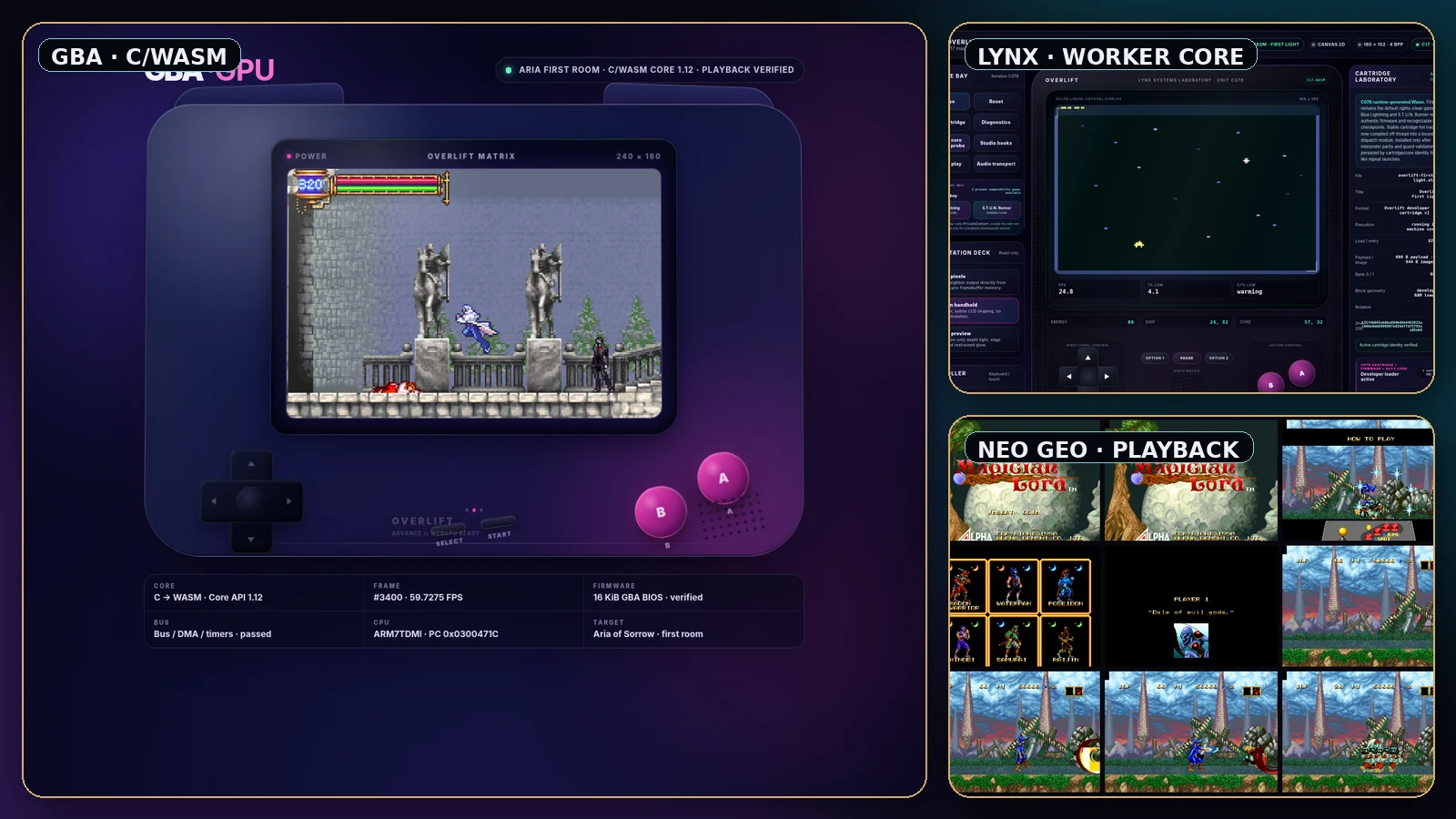
OverLift Emulator Suite montage showing Game Boy Advance, Lynx, and Neo Geo browser runtimes
Real product view The product is shown before the deeper technical story.
  1. 01
    Authentic machine statePreserve timing, input, audio, video, and save behavior under one exact authority.
  2. 02
    Browser-native playRun locally with modern workers, graphics paths, controls, and audio continuity.
  3. 03
    Measured compatibilityProve title behavior, fallbacks, replay, and deoptimization instead of guessing.
MARKETING

Make the useful difference easy to understand and remember.

The complete audience, competitive, and positioning story begins here.

A family of browser-native console, handheld, arcade, and home-computer runtimes built from authoritative C17/WebAssembly cores. The suite combines exact machine state, low-latency input and audio, compatibility evidence, diagnostics, replay, and carefully gated acceleration.

Why it stands apart: Many emulator projects optimize one platform or hide timing problems behind a playable-looking frame. The OverLift suite applies one repeatable exactness contract across very different machines: every faster path is compared with authority, deoptimizes on mismatch, and leaves evidence a compatibility engineer can inspect.

PRODUCT SIGNALSWhy people notice and remember the product
  1. 01Exact real-time execution
  2. 02Adaptive verified performance
  3. 03Semantic remaster tooling
  4. 04Smooth real-time operation
  5. 05No silent correctness tradeoffs
  6. 06Reusable systems-engineering proof
BUSINESS / EXECUTIVE

Create a reusable runtime program where performance gains never quietly redefine correctness.

Run classic machines in the browser with exact state, smooth timing, visible diagnostics, and safe acceleration.

The program brings performance, exactness, observability, and graceful recovery together instead of trading one away for another.

Executive case: Many emulator projects optimize one platform or hide timing problems behind a playable-looking frame. The OverLift suite applies one repeatable exactness contract across very different machines: every faster path is compared with authority, deoptimizes on mismatch, and leaves evidence a compatibility engineer can inspect.

VALUE AND PROOFWhat a leader can defend, measure, or operationalize
  1. 01Smooth real-time operation
  2. 02No silent correctness tradeoffs
  3. 03Reusable systems-engineering proof
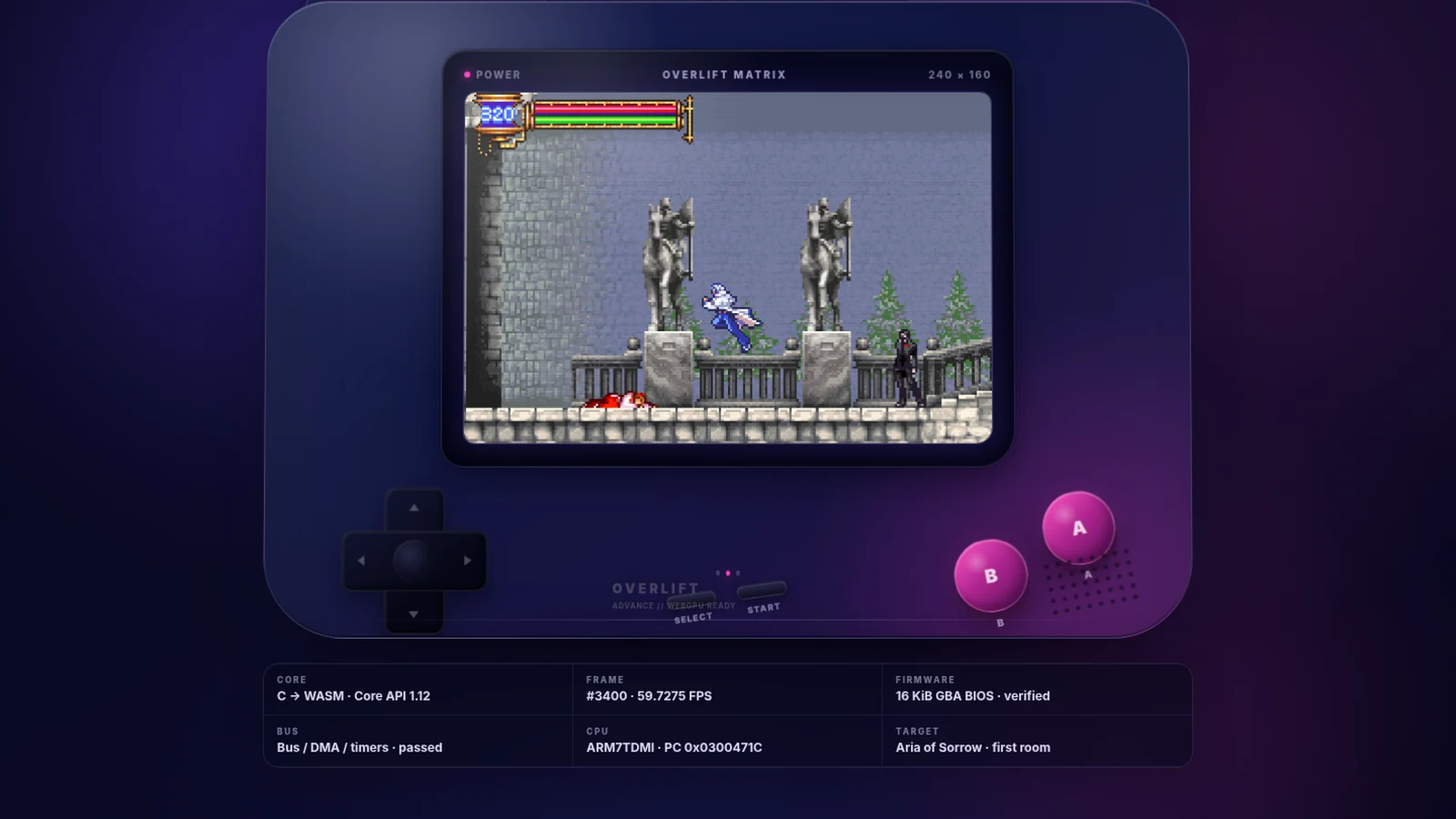
  4. 04Verified GBA Aria of Sorrow first-room playback
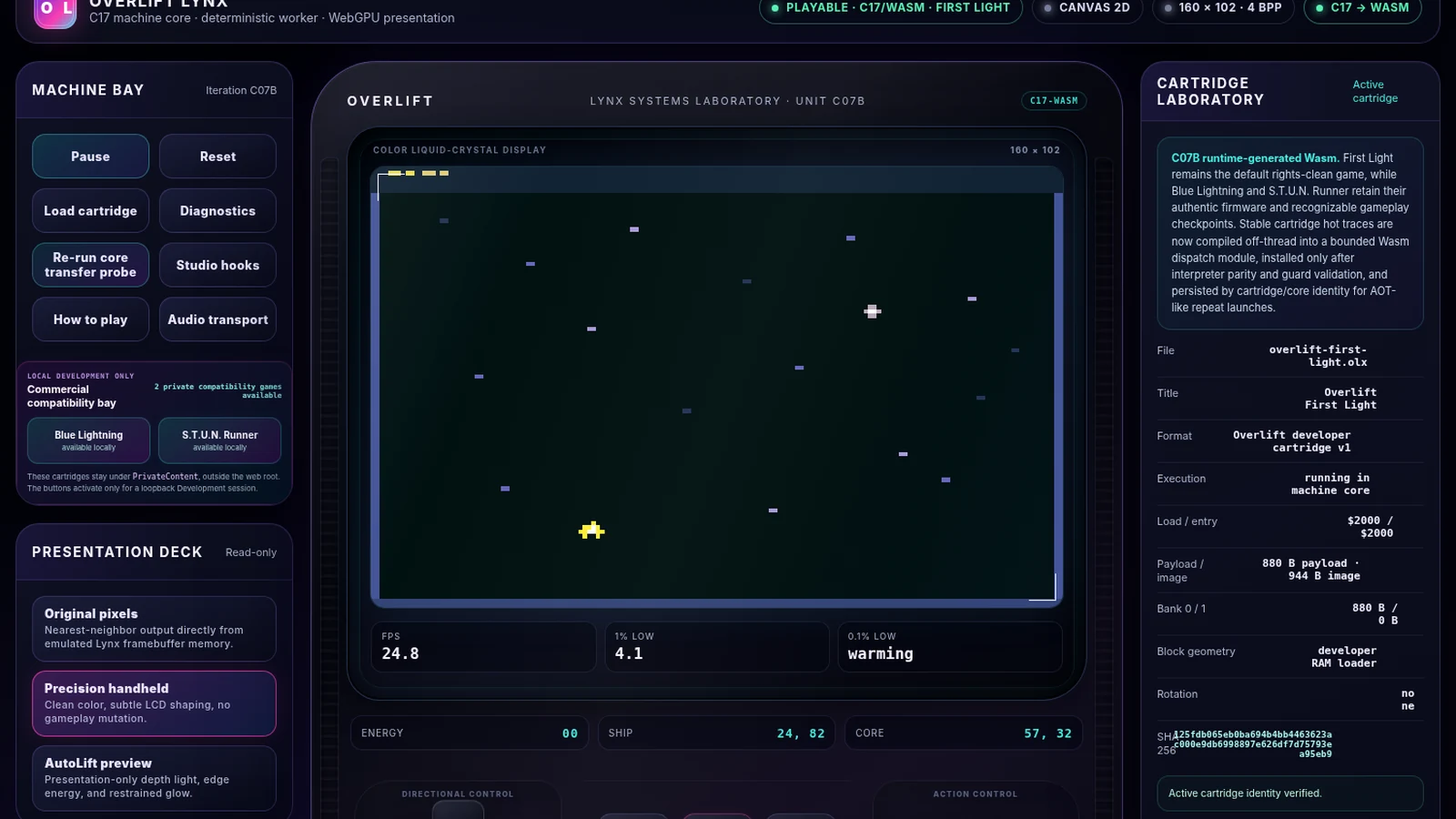
  5. 05Lynx First Light machine bay and cartridge laboratory
  6. 06Neo Geo Magician Lord title, selection, and gameplay progression
ARCHITECTURE

One exact C17/WebAssembly machine authority supports many consoles, handhelds, arcades, and computers.

The Semantic Bridge can convert verified machine provenance into layers, entities, events, accessibility data, search, remaster controls, and agent-readable context without inventing game semantics. AI may assist classification, diagnostics, restoration, and authoring, while the machine core remains exact authority.

I built a family of browser emulator laboratories around one OverLift contract: an authoritative C17/WebAssembly machine core, worker-owned state, bounded video and audio transport, deterministic inputs, visible diagnostics, exact fallback, and compatibility evidence gathered from real games.

Authority boundary: The OverLift method keeps one exact machine state as authority, tests every faster path against it, falls back at the first mismatch, and records compatibility evidence. Performance may improve; the definition of correct behavior does not move.

  1. 01

    Load a verified game image and identify the exact machine configuration.

  2. 02

    Run the authoritative machine state inside the browser worker.

  3. 03

    Move video, audio, and input through bounded channels with diagnostics visible.

  4. 04

    Test faster execution only against the exact reference behavior.

  5. 05

    Fall back immediately when timing, state, or output disagrees.

  6. 06

    Record compatibility evidence so the next test begins from facts, not memory.

ENGINEERING

Workers, bounded transport, audio continuity, compatibility evidence, and exact deoptimization.

Real-time emulation exposes weak architecture immediately. Timing drift, audio underruns, stale state, bad optimization, and hidden divergence all become visible. That makes the suite a demanding laboratory for techniques later reused in enterprise systems.

I designed the shared runtime rules, browser machine bays, C17/WebAssembly authority pattern, worker and audio transport, deterministic diagnostics, compatibility workflow, acceleration research, and Semantic Bridge direction used across the emulator program.

Technology stackC17/WebAssembly, Web Workers, SharedArrayBuffer, AudioWorklet, WebGPU, OverLift AEX, Tier-S, CATS, Semantic Bridge
IMPLEMENTED ENGINEERINGWorking systems and verified boundaries
  1. 01C17/WebAssembly browser cores and machine-specific workbenches across multiple systems
  2. 02Worker-owned execution, input controls, diagnostics, and game-loading workflows
  3. 03Compatibility evidence and exact fallback patterns
  4. 04One authoritative C17/WebAssembly machine worker
  5. 05Tiered acceleration with shadow verification and exact deoptimization
  6. 06Semantic Bridge outputs for accessibility, diagnostics, and remaster workflows
OVERLIFT METHOD

How OverLift makes OverLift Emulator Suite adaptive without surrendering authority.

The OverLift method keeps one exact machine state as authority, tests every faster path against it, falls back at the first mismatch, and records compatibility evidence. Performance may improve; the definition of correct behavior does not move.

  1. T0
    Exact baseline

    Define the authoritative result before adding acceleration, semantics, or agents.

  2. T1
    Measured evidence

    Instrument state, latency, quality, and failure so improvement is observable.

  3. T2
    Bounded ownership

    Move expensive or high-frequency work behind clear worker and memory boundaries.

  4. T3
    Deterministic transport

    Version messages, snapshots, identities, deadlines, and replay inputs.

  5. T4
    Semantic assistance

    Let local retrieval and models propose meaning only inside admitted evidence.

  6. T5
    Candidate paths

    Compare several allowed next actions with explicit risk, cost, fit, and uncertainty.

  7. T6
    Shadow verification

    Challenge the production route without giving the challenger authority.

  8. T7
    Governed production

    Promote only measured, replayable paths with fallback and operational receipts.

  9. Tier-S
    Experimental challenger

    Run advanced evaluators in shadow, compare them with the control, and graduate only repeatable gains.

CATS

Context-Aware Tier Selection

CATS chooses the least risky qualified execution tier for the current evidence, device, latency, authority, and failure context. The product does not run its most advanced path merely because it exists.

SEMANTIC BRIDGE

Meaning becomes typed product state

The Semantic Bridge translates human goals, documents, events, or observations into explicit entities, evidence, uncertainty, tools, and permissions. It preserves missing and contradictory information instead of smoothing it away.

DETERMINISM

One official result, evidence, and replay path

Models may retrieve, classify, compare, or propose. Exact software remains the authority over admitted facts, legal actions, state transitions, approval, execution, and the receipt that proves what happened.

Read the complete OverLift Method Explore OverLift security Run the OverLift demonstration Explore the Agentic AI Glossary
BROWSER-BASED AGENTIC AI SYSTEM

The real-time systems laboratory for the Browser-Based Agentic AI System.

OverLift Emulator Suite is one vertical proof inside a wider browser-based system. The point is not to force every product through identical technology; it is to apply the right combination of local intelligence, retrieval, sandboxing, explicit capabilities, agents, deterministic authority, and proof without turning any of them into marketing checkboxes.

CAPABILITY PROOFWhat is active, shared, bounded, or authoritative in this product
  1. 01 ACTIVE IN PRODUCT

    Browser-native product surface

    The working interface, local execution path, or browser-class runtime makes the system inspectable, portable, and available without hiding the product behind an API demo.

  2. 02 ACTIVE PRIVACY BOUNDARY

    Privacy and minimum disclosure

    Sensitive context is processed locally, same-origin, or offline where the product benefits. Any provider-bound step is intentionally scoped instead of receiving the complete product history.

  3. 03 ACTIVE IN PRODUCT

    Narrow agents and typed tools

    Agents receive bounded context, explicit capabilities, deadlines, and typed tools. They may retrieve, classify, compare, explain, or propose; they may not silently expand their own authority.

  4. 04 ACTIVE IN PRODUCT

    RAG and vector evidence

    Local or governed retrieval builds an evidence set before reasoning. Vector similarity proposes useful context, while source identity, freshness, access, and deterministic admission decide what the product may trust.

  5. 05 ACTIVE IN PRODUCT

    C17 / WebAssembly kernel

    A WebAssembly authority path keeps exact state, validation, and replay separate from probabilistic assistance. Faster or more creative layers cannot redefine the official result.

  6. 06 ACTIVE SECURITY BOUNDARY

    Security and least privilege

    ROM input, worker transport, graphics paths, audio helpers, cheats, and diagnostics are separated from the C17/WebAssembly machine authority. Bounded messages, integrity checks, exact fallback, and compatibility replay reduce the blast radius of malformed media or optimized code.

  7. 07 ACTIVE IN PRODUCT

    Receipts, replay, and evaluation

    Important inputs, candidate paths, approvals, state changes, and outcomes remain inspectable through receipts, traces, reversible operations, replay, or exact comparisons appropriate to the product.

Evidence-bound RAG Source and identity checks Narrow agents Typed tools Sandboxed execution Explicit capability allowlists Least privilege Local-first privacy Minimum disclosure Human approval Abstention and fail-closed paths Receipts, replay, and evaluation
What this proves The GBA, Lynx, and Neo Geo screens show actual browser runtimes, game output, controls, cartridge or firmware identity, and performance evidence. They prove that the shared architecture is being exercised across very different machines. They do not claim that every game is already compatible.
PRODUCT PROOF

These are real project views from the actual work—not generic stock illustration. They connect the product story to an interface, workflow, or result a visitor can inspect.