REAL-TIME GENERATIVE EXPLORATION · BUILT WITH OVERLIFT

Fractal Observatory

Explore infinite visual worlds without losing smoothness—or the path back.

Fractal Observatory turns mathematical exploration into a fluid, navigable visual instrument. People can move through complex scenes, preserve discoveries, and let local intelligence help shape the journey without sacrificing frame rate, reversibility, or control of the renderer.

Explore the observatory Follow the product story
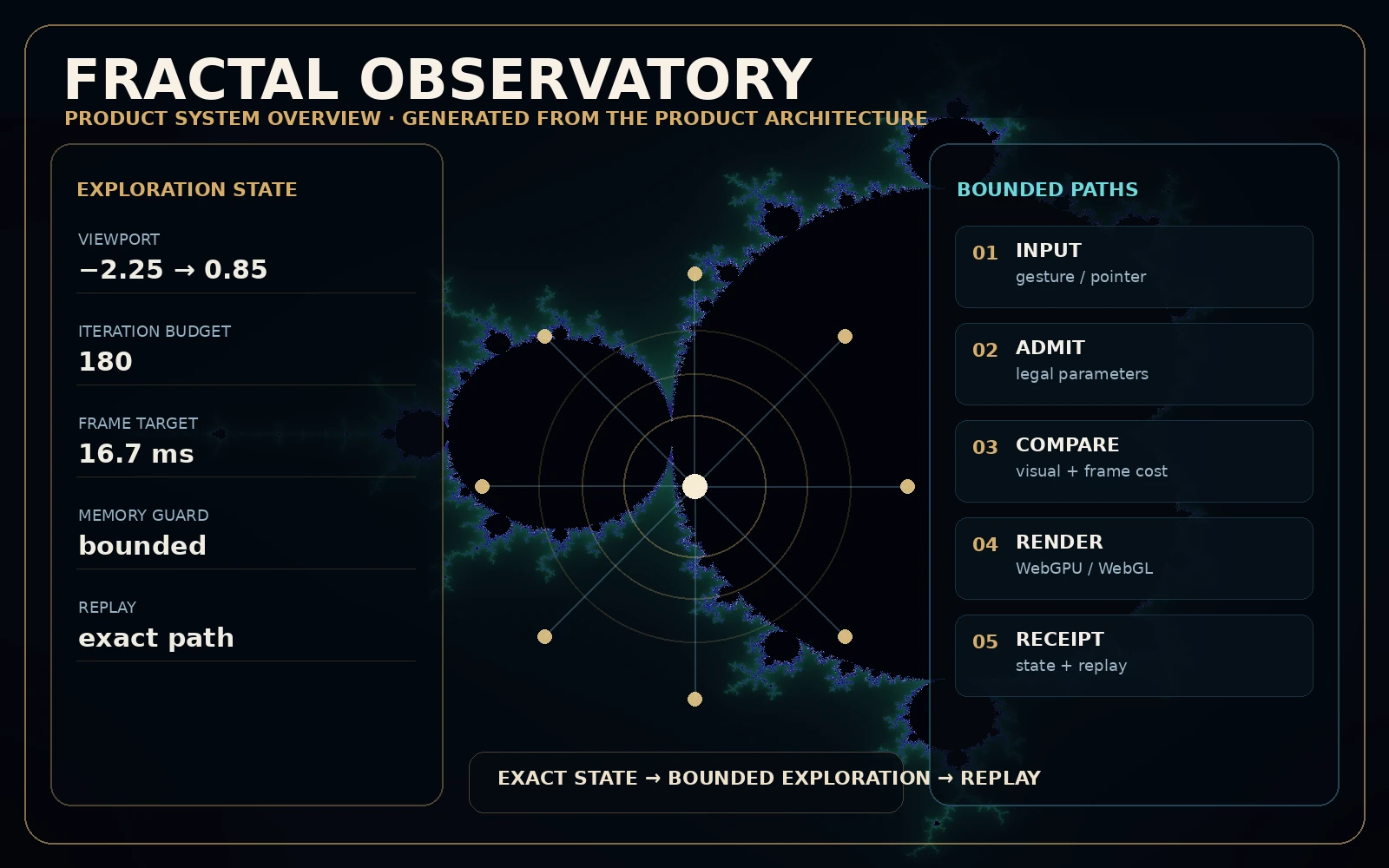
Fractal Observatory product system overview showing a bounded fractal field, parameter paths, performance budgets, and replay state
Real product view The product is shown before the deeper technical story.
  1. 01
    Fluid explorationProtect interaction and frame cadence while the visual world becomes more complex.
  2. 02
    Remembered discoveriesPreserve meaningful locations, parameters, journeys, and return paths.
  3. 03
    Bounded generationKeep learned suggestions inside typed renderer inputs and resource budgets.
MARKETING

Make the useful difference easy to understand and remember.

The complete audience, competitive, and positioning story begins here.

A real-time visual exploration engine for immersive motion, technical art, and performance-conscious discovery. It connects user movement to bounded rendering parameters, monitors frame and memory budgets, and preserves the state needed to revisit or compare a scene.

Why it stands apart: Randomized visualizers can produce one striking frame but cannot explain or reproduce it. Fractal Observatory explores parameter paths under explicit performance and coherence limits, rejects combinations that would stutter, and remembers how each scene was reached.

PRODUCT SIGNALSWhy people notice and remember the product
  1. 01Performance rendering
  2. 02Interactive exploration
  3. 03Creative local inference
  4. 04Longer exploratory sessions
  5. 05More memorable visual identity
  6. 06A clearer bridge between art and engineering
BUSINESS / EXECUTIVE

Demonstrate that visual ambition can coexist with frame budgets, evidence, and repeatable state.

Explore a rich visual world smoothly, understand how it changed, and return to any scene you discover.

It communicates that visually rich software can still be measured, optimized, and architected with discipline.

Executive case: Randomized visualizers can produce one striking frame but cannot explain or reproduce it. Fractal Observatory explores parameter paths under explicit performance and coherence limits, rejects combinations that would stutter, and remembers how each scene was reached.

VALUE AND PROOFWhat a leader can defend, measure, or operationalize
  1. 01Longer exploratory sessions
  2. 02More memorable visual identity
  3. 03A clearer bridge between art and engineering
ARCHITECTURE

User intent, render parameters, performance limits, and scene history form a bounded exploration state.

Edge AI is imagined here as a local creative companion that studies user movement, remembers preferred visual motifs, and proposes new render parameters in real time without shipping the exploration history to a cloud service.

I built Fractal Observatory as a performance-conscious interactive rendering system. It connects user movement to bounded parameter changes, watches frame and memory budgets, preserves important scene state, and creates room for local pattern recognition to suggest new directions without taking control of the rendering truth.

Authority boundary: The OverLift method turns rendering choices, user input, frame-time limits, memory limits, and visual goals into explicit state. It can compare several parameter paths, reject combinations that break the performance budget, and preserve the sequence that produced a scene so exploration remains creative without becoming random or irreproducible.

  1. 01

    Begin with the current scene, user movement, and active performance budget.

  2. 02

    Translate the interaction into a bounded set of rendering parameters.

  3. 03

    Generate several viable visual directions instead of applying an uncontrolled random change.

  4. 04

    Reject paths that exceed frame-time, memory, or visual-coherence limits.

  5. 05

    Render the selected state and keep the parameter sequence available for replay.

  6. 06

    Use the observed result to guide the next exploration without hiding the exact renderer state.

ENGINEERING

WebGL rendering, frame telemetry, parameter-path search, local preference memory, and reproducible scenes.

This project lets the portfolio show aesthetic range while still sounding like an engineer: every flourish is grounded in performance and system intent.

I designed the interaction model, rendering and performance boundaries, parameter-state structure, replay direction, local creative-assistance concept, and the product presentation that connects technical graphics work to an understandable exploratory experience.

Technology stackWebGL, rendering pipelines, interaction systems
IMPLEMENTED ENGINEERINGWorking systems and verified boundaries
  1. 01Local pattern recognition for motif recall
  2. 02Gesture-informed parameter search
  3. 03Graphics pipeline tuned for smooth exploratory motion
OVERLIFT METHOD

How OverLift makes Fractal Observatory adaptive without surrendering authority.

The OverLift method turns rendering choices, user input, frame-time limits, memory limits, and visual goals into explicit state. It can compare several parameter paths, reject combinations that break the performance budget, and preserve the sequence that produced a scene so exploration remains creative without becoming random or irreproducible.

  1. T0
    Exact baseline

    Define the authoritative result before adding acceleration, semantics, or agents.

  2. T1
    Measured evidence

    Instrument state, latency, quality, and failure so improvement is observable.

  3. T2
    Bounded ownership

    Move expensive or high-frequency work behind clear worker and memory boundaries.

  4. T3
    Deterministic transport

    Version messages, snapshots, identities, deadlines, and replay inputs.

  5. T4
    Semantic assistance

    Let local retrieval and models propose meaning only inside admitted evidence.

  6. T5
    Candidate paths

    Compare several allowed next actions with explicit risk, cost, fit, and uncertainty.

  7. T6
    Shadow verification

    Challenge the production route without giving the challenger authority.

  8. T7
    Governed production

    Promote only measured, replayable paths with fallback and operational receipts.

  9. Tier-S
    Experimental challenger

    Run advanced evaluators in shadow, compare them with the control, and graduate only repeatable gains.

CATS

Context-Aware Tier Selection

CATS chooses the least risky qualified execution tier for the current evidence, device, latency, authority, and failure context. The product does not run its most advanced path merely because it exists.

SEMANTIC BRIDGE

Meaning becomes typed product state

The Semantic Bridge translates human goals, documents, events, or observations into explicit entities, evidence, uncertainty, tools, and permissions. It preserves missing and contradictory information instead of smoothing it away.

DETERMINISM

One official result, evidence, and replay path

Models may retrieve, classify, compare, or propose. Exact software remains the authority over admitted facts, legal actions, state transitions, approval, execution, and the receipt that proves what happened.

Read the complete OverLift Method Explore OverLift security Run the OverLift demonstration Explore the Agentic AI Glossary
BROWSER-BASED AGENTIC AI SYSTEM

The real-time creative-agent and rendering proof in the Browser-Based Agentic AI System.

Fractal Observatory is one vertical proof inside a wider browser-based system. The point is not to force every product through identical technology; it is to apply the right combination of local intelligence, retrieval, sandboxing, explicit capabilities, agents, deterministic authority, and proof without turning any of them into marketing checkboxes.

CAPABILITY PROOFWhat is active, shared, bounded, or authoritative in this product
  1. 01 ACTIVE IN PRODUCT

    Browser-native product surface

    The working interface, local execution path, or browser-class runtime makes the system inspectable, portable, and available without hiding the product behind an API demo.

  2. 02 ACTIVE PRIVACY BOUNDARY

    Privacy and minimum disclosure

    Sensitive context is processed locally, same-origin, or offline where the product benefits. Any provider-bound step is intentionally scoped instead of receiving the complete product history.

  3. 03 BOUNDED PLATFORM ROLE

    Narrow agents and typed tools

    This vertical contributes deterministic product state to the shared agent fabric. Any future agent remains narrow, permission-bound, and unable to invent executable capabilities.

  4. 04 SHARED WHEN NEEDED

    RAG and vector evidence

    The shared platform can add local vector retrieval when semantic memory improves the product. It does not force a vector database into a workflow where exact state is already the better authority.

  5. 05 SHARED AUTHORITY PATH

    C17 / WebAssembly kernel

    This product keeps an explicit deterministic authority boundary and can use the shared C17/WebAssembly kernel where browser-local validation, exact replay, or protected state transitions are required.

  6. 06 GOVERNED SECURITY PATH

    Security and least privilege

    Generated parameters and local preference memory are constrained to typed renderer inputs, frame budgets, allowed assets, and reversible scene state. They do not receive arbitrary DOM, network, storage, or device authority.

  7. 07 SHARED PROOF SYSTEM

    Receipts, replay, and evaluation

    The shared proof layer can record the evidence and decision path without forcing the product to expose internal model chatter or unverifiable chain-of-thought.

Evidence-bound RAG Source and identity checks Narrow agents Typed tools Sandboxed execution Explicit capability allowlists Least privilege Local-first privacy Minimum disclosure Human approval Abstention and fail-closed paths Receipts, replay, and evaluation
What this proves The product exposes the visual result together with the parameter state and performance behavior that created it. A scene can be revisited, compared with another path, and evaluated by frame-time and coherence rather than judged only by whether one random image looked impressive.