CONNECTED AZURE LEARNING · BUILT WITH OVERLIFT

AzureGlossary

Stop memorizing Azure. Start understanding how it connects.

AzureGlossary turns thousands of terms, commands, services, scenarios, and exam objectives into a guided learning system. Learners can ask naturally, follow relationships, practice real operations, and understand why an answer is right instead of memorizing isolated definitions.

Explore the learning system Follow the product story
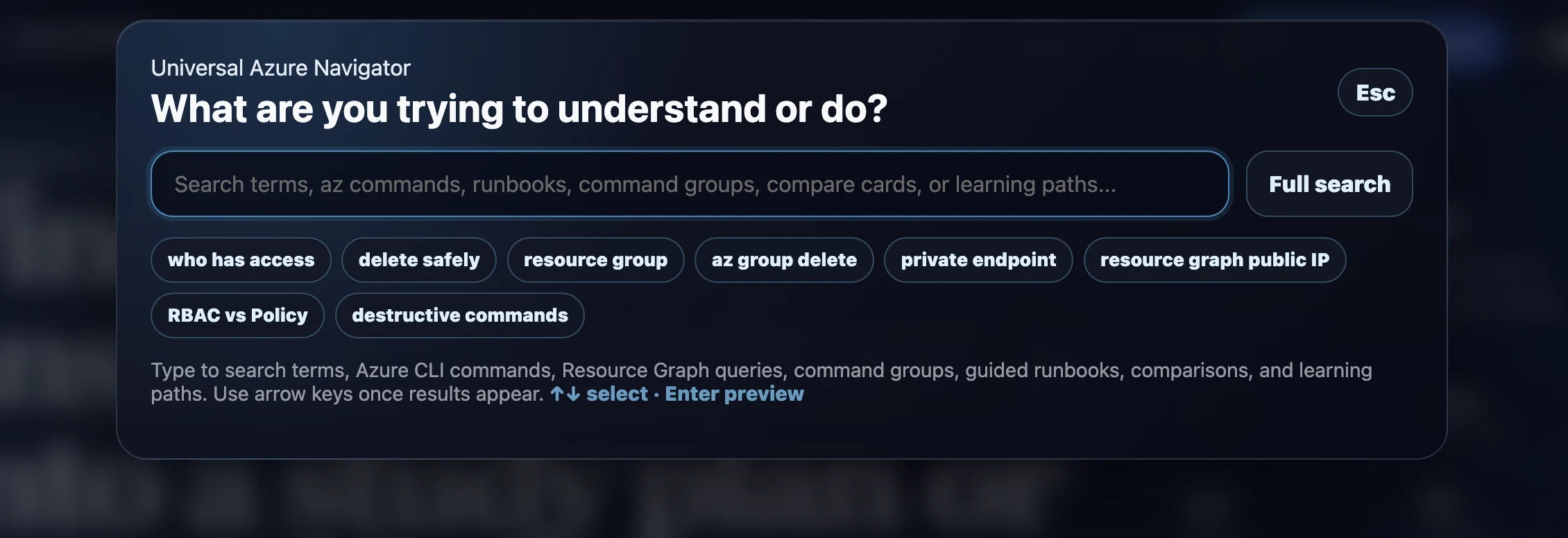
Universal Azure navigator Ctrl-K search surface
Real product view The product is shown before the deeper technical story.
  1. 01
    Connected conceptsMove from one Azure idea into related services, tradeoffs, and practical context.
  2. 02
    Command-rich practicePair definitions with safe CLI workflows, scenarios, and exam-ready reasoning.
  3. 03
    Measured retrievalEvaluate ranking, citation quality, abstention, duplication, and learning-path fit.
MARKETING

Make the useful difference easy to understand and remember.

The complete audience, competitive, and positioning story begins here.

A connected Azure learning and reference platform with more than 2,000 terms, 5,000-plus CLI references, reviewed certification tracks, official-source links, semantic search, and guided operational tools. It helps learners move from the question they actually have to the right concept, command, source, or study step.

Why it stands apart: Instead of forcing users to choose between fragmented documentation, exam cramming, and a generic chatbot, AzureGlossary connects vocabulary, commands, objectives, and official evidence in one deterministic knowledge graph. Semantic search improves discovery while Microsoft documentation remains the authority.

PRODUCT SIGNALSWhy people notice and remember the product
  1. 01Connected Azure reference
  2. 02Safer CLI guidance
  3. 03Certification diagnostics
  4. 04Clearer Azure learning paths
  5. 05Faster concept lookup
  6. 06Stronger proof of practical Azure + AI product design
BUSINESS / EXECUTIVE

Create a durable learning asset that supports certification, onboarding, and practical cloud reasoning.

Start with the Azure question you actually have and reach the right concept, command, source, or study step.

The engineering signal is practical product architecture: Azure fluency, search ergonomics, content modeling, CLI safety, exam-prep structure, and restrained AI design working together as one system.

Executive case: Instead of forcing users to choose between fragmented documentation, exam cramming, and a generic chatbot, AzureGlossary connects vocabulary, commands, objectives, and official evidence in one deterministic knowledge graph. Semantic search improves discovery while Microsoft documentation remains the authority.

VALUE AND PROOFWhat a leader can defend, measure, or operationalize
  1. 01Clearer Azure learning paths
  2. 02Faster concept lookup
  3. 03Stronger proof of practical Azure + AI product design
  4. 04Connected universal navigation across reference and exam intent
  5. 05DP-900 diagnostic and repair flow as the learning-system reference implementation
  6. 06Production deployment on Azure with blob-backed media
ARCHITECTURE

A source-bound knowledge graph connects canonical concepts, commands, scenarios, learning paths, and semantic search.

A local Gemma-family model layer is planned as a constrained explanation and routing layer. Its job is to summarize curated entries, compare related ideas, classify user intent, and route people toward the right glossary term, command context, or study repair path. It is not the source of truth.

I built AzureGlossary as one connected Azure learning and reference product. It brings together more than 2,000 terms, thousands of CLI references, guided runbooks, comparisons, Resource Graph queries, labs, and twelve reviewed exam routes in a searchable ASP.NET and Azure application.

Authority boundary: The OverLift method connects a learner's question to curated terms, commands, objectives, and official sources; keeps Microsoft documentation as authority; and chooses the next learning step from evidence instead of generic chat. The result is easier to understand and safer to apply.

  1. 01

    Begin with a term, command, error, comparison, or exam goal.

  2. 02

    Route the request to the right reference, tool, or learning path.

  3. 03

    Connect the answer to architecture, identity, scope, risk, and official sources.

  4. 04

    Use diagnostics to find the reasoning gap rather than only marking an answer wrong.

  5. 05

    Practice the weak concept through focused repair and retesting.

  6. 06

    Keep Microsoft documentation as the authority while the product supplies the connections.

ENGINEERING

Local vector search, deterministic ranking, WebAssembly authority, receipts, and browser learning state.

The next build pass adds the local model route, deeper term relationships, more Microsoft Learn-backed records, and stronger command-safety flows while keeping the current interface and blob-backed media foundation intact.

I designed and built the product architecture, Azure content model, search and navigation experience, exam workflow, command-safety presentation, media and deployment path, and the learning-system direction that will support semantic retrieval and adaptive repair.

Technology stackASP.NET Core, Azure Blob media, Ctrl-K search UX, Azure CLI context, 12 exam routes: AZ-802, AZ-104, AZ-900, AZ-305, AZ-400, AZ-700, DP-900, SC-900, SC-500, AI-901, AI-103, AI-200
IMPLEMENTED ENGINEERINGWorking systems and verified boundaries
  1. 012,003 Azure terms and 5,357 unique CLI reference entries
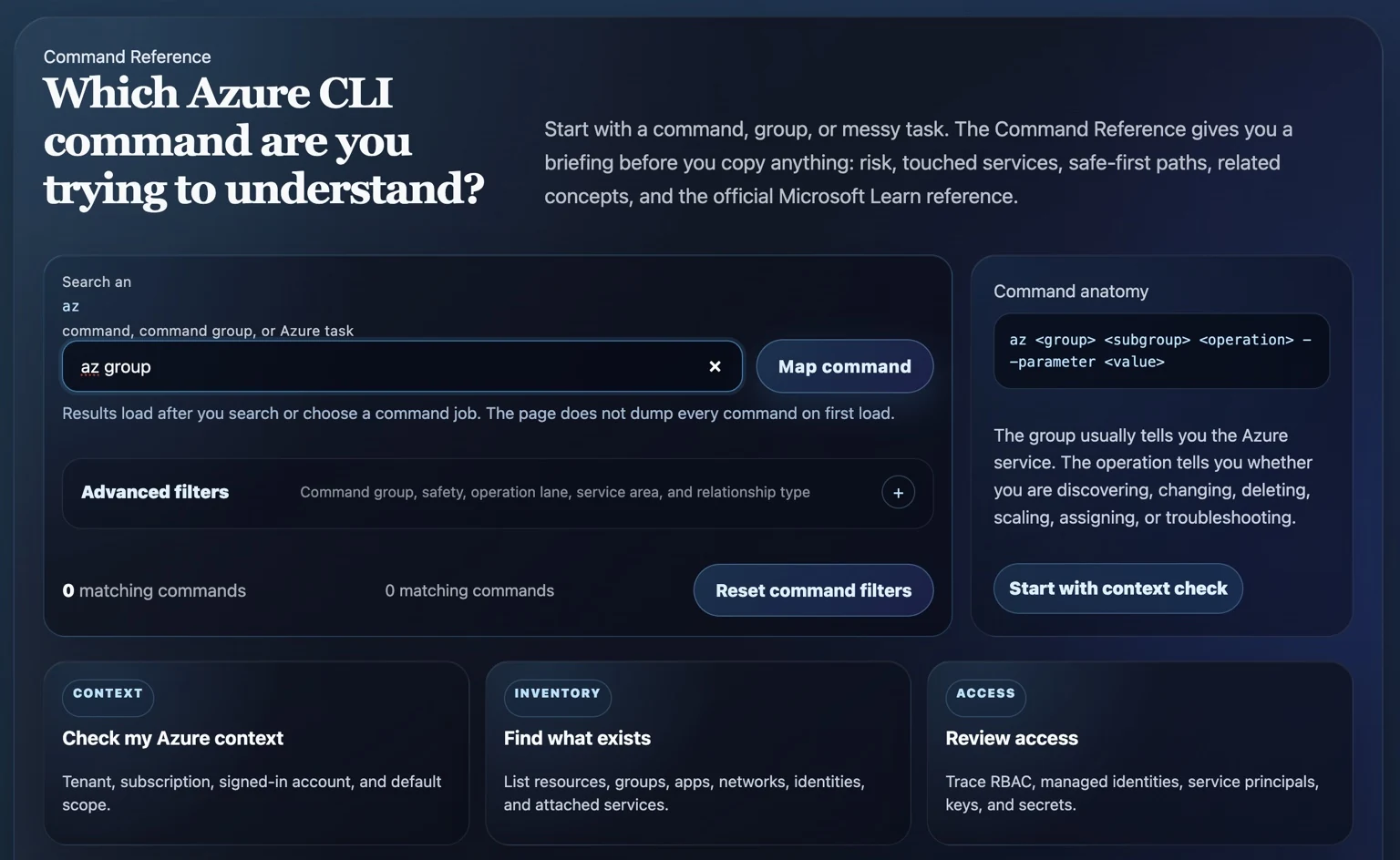
  2. 02Search, glossary, commands, runbooks, comparisons, Resource Graph, labs, and learning paths
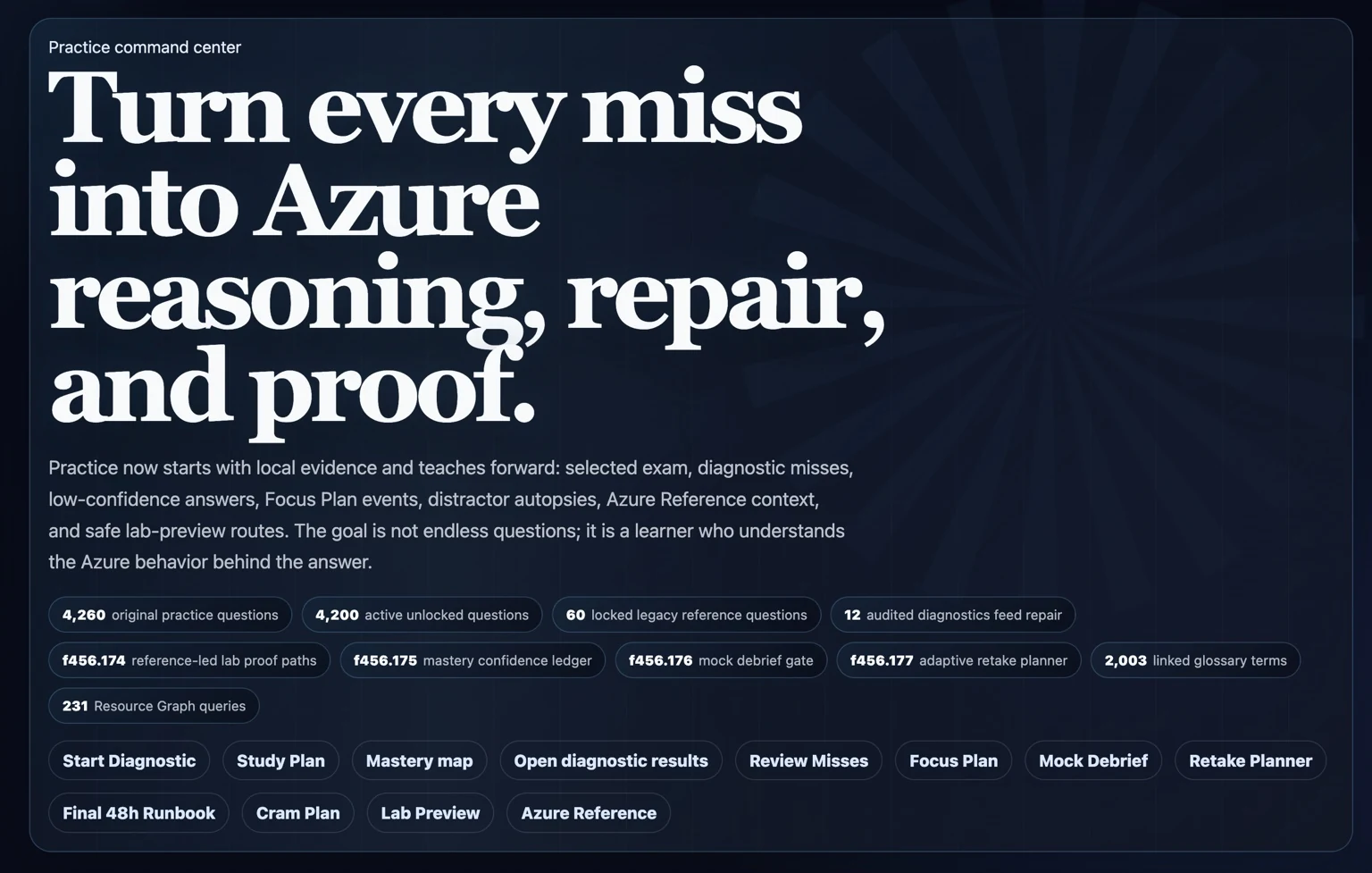
  3. 03Twelve reviewed certification routes with free diagnostics and repair surfaces
  4. 04Intent-first Azure navigator for terms, commands, runbooks, comparisons, and learning paths
  5. 05Twelve named routes: AZ-802, AZ-104, AZ-900, AZ-305, AZ-400, AZ-700, DP-900, SC-900, SC-500, AI-901, AI-103, and AI-200
  6. 06Glossary records that connect concepts to CLI context, Microsoft Learn source paths, and exam repair flows
OVERLIFT METHOD

How OverLift makes AzureGlossary adaptive without surrendering authority.

The OverLift method connects a learner's question to curated terms, commands, objectives, and official sources; keeps Microsoft documentation as authority; and chooses the next learning step from evidence instead of generic chat. The result is easier to understand and safer to apply.

  1. T0
    Exact baseline

    Define the authoritative result before adding acceleration, semantics, or agents.

  2. T1
    Measured evidence

    Instrument state, latency, quality, and failure so improvement is observable.

  3. T2
    Bounded ownership

    Move expensive or high-frequency work behind clear worker and memory boundaries.

  4. T3
    Deterministic transport

    Version messages, snapshots, identities, deadlines, and replay inputs.

  5. T4
    Semantic assistance

    Let local retrieval and models propose meaning only inside admitted evidence.

  6. T5
    Candidate paths

    Compare several allowed next actions with explicit risk, cost, fit, and uncertainty.

  7. T6
    Shadow verification

    Challenge the production route without giving the challenger authority.

  8. T7
    Governed production

    Promote only measured, replayable paths with fallback and operational receipts.

  9. Tier-S
    Experimental challenger

    Run advanced evaluators in shadow, compare them with the control, and graduate only repeatable gains.

CATS

Context-Aware Tier Selection

CATS chooses the least risky qualified execution tier for the current evidence, device, latency, authority, and failure context. The product does not run its most advanced path merely because it exists.

SEMANTIC BRIDGE

Meaning becomes typed product state

The Semantic Bridge translates human goals, documents, events, or observations into explicit entities, evidence, uncertainty, tools, and permissions. It preserves missing and contradictory information instead of smoothing it away.

DETERMINISM

One official result, evidence, and replay path

Models may retrieve, classify, compare, or propose. Exact software remains the authority over admitted facts, legal actions, state transitions, approval, execution, and the receipt that proves what happened.

Read the complete OverLift Method Explore OverLift security Run the OverLift demonstration Explore the Agentic AI Glossary
BROWSER-BASED AGENTIC AI SYSTEM

The knowledge, RAG, vector, and learning proof inside the Browser-Based Agentic AI System.

AzureGlossary is one vertical proof inside a wider browser-based system. The point is not to force every product through identical technology; it is to apply the right combination of local intelligence, retrieval, sandboxing, explicit capabilities, agents, deterministic authority, and proof without turning any of them into marketing checkboxes.

CAPABILITY PROOFWhat is active, shared, bounded, or authoritative in this product
  1. 01 ACTIVE IN PRODUCT

    Browser-native product surface

    The working interface, local execution path, or browser-class runtime makes the system inspectable, portable, and available without hiding the product behind an API demo.

  2. 02 ACTIVE PRIVACY BOUNDARY

    Privacy and minimum disclosure

    Sensitive context is processed locally, same-origin, or offline where the product benefits. Any provider-bound step is intentionally scoped instead of receiving the complete product history.

  3. 03 BOUNDED PLATFORM ROLE

    Narrow agents and typed tools

    This vertical contributes deterministic product state to the shared agent fabric. Any future agent remains narrow, permission-bound, and unable to invent executable capabilities.

  4. 04 SHARED WHEN NEEDED

    RAG and vector evidence

    The shared platform can add local vector retrieval when semantic memory improves the product. It does not force a vector database into a workflow where exact state is already the better authority.

  5. 05 SHARED AUTHORITY PATH

    C17 / WebAssembly kernel

    This product keeps an explicit deterministic authority boundary and can use the shared C17/WebAssembly kernel where browser-local validation, exact replay, or protected state transitions are required.

  6. 06 GOVERNED SECURITY PATH

    Security and least privilege

    Same-origin MiniLM and local vectors propose related concepts inside a worker boundary. Reviewed sources, canonical mappings, access rules, freshness, deterministic fusion, and receipts decide what may enter the answer; query text cannot invent a tool or policy exception.

  7. 07 ACTIVE IN PRODUCT

    Receipts, replay, and evaluation

    Important inputs, candidate paths, approvals, state changes, and outcomes remain inspectable through receipts, traces, reversible operations, replay, or exact comparisons appropriate to the product.

Evidence-bound RAG Source and identity checks Narrow agents Typed tools Sandboxed execution Explicit capability allowlists Least privilege Local-first privacy Minimum disclosure Human approval Abstention and fail-closed paths Receipts, replay, and evaluation
What this proves The universal navigator, practice command center, and command-reference screens are real product surfaces. They show connected search, diagnostic repair, and command context rather than a collection of static marketing mockups. The live AzureGlossary site provides the broader working product.
PRODUCT PROOF

These are real project views from the actual work—not generic stock illustration. They connect the product story to an interface, workflow, or result a visitor can inspect.