GOVERNED EDITORIAL AI · BUILT WITH OVERLIFT

Article Studio

Turn research into publishable work without losing the sources—or the final say.

Article Studio helps content teams collect evidence, shape angles, draft, revise, package media, and move toward publication in one accountable workspace. It accelerates the expensive parts of editorial production while keeping voice, sources, review, budget, and publication authority visible.

See the editorial workflow Follow the product story
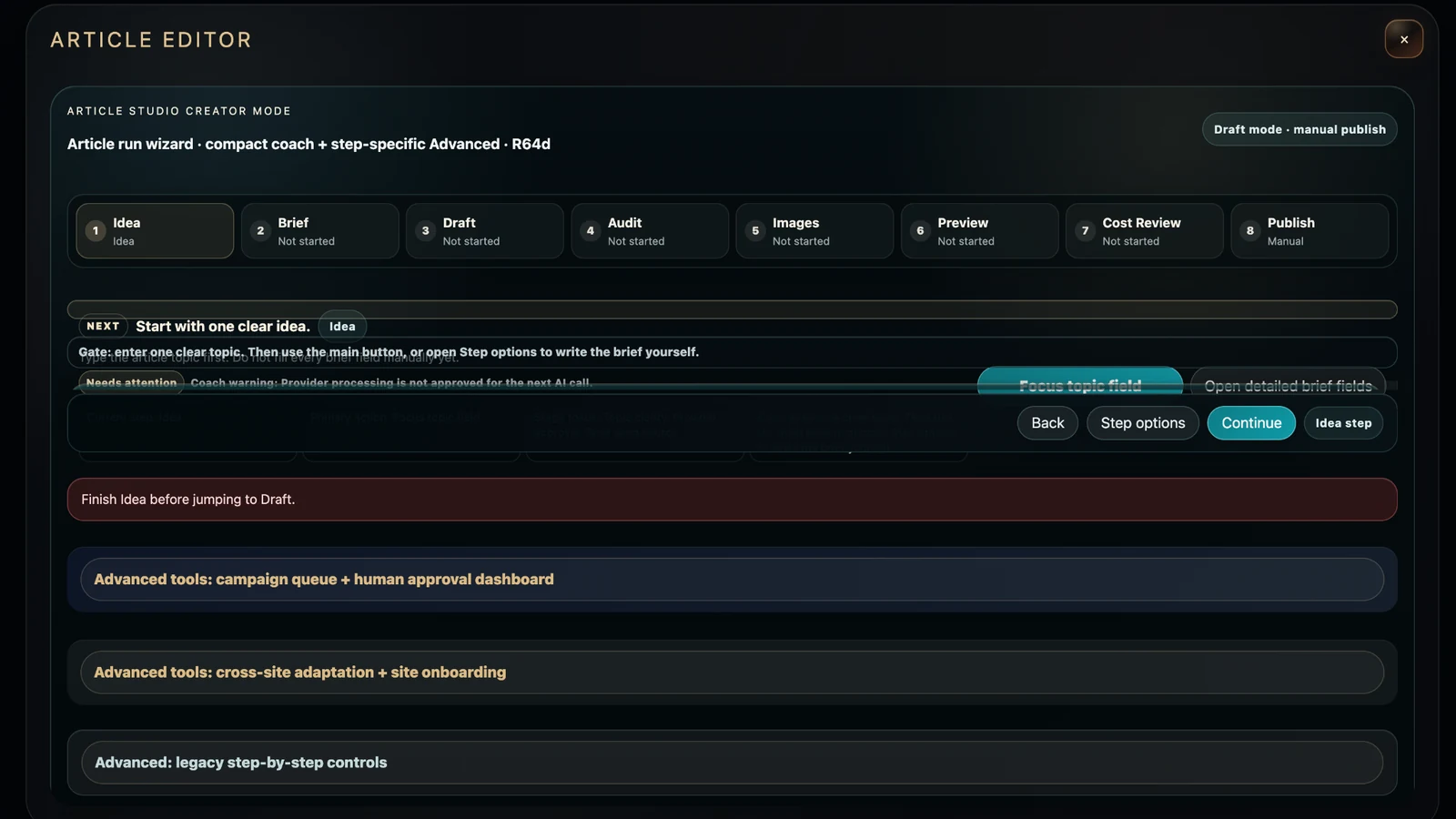
Article Studio creator wizard showing the eight-stage guided content workflow
Real product view The product is shown before the deeper technical story.
  1. 01
    Source-groundedKeep research, claims, quotations, and links attached to inspectable evidence.
  2. 02
    Editorial controlPreserve voice, review state, budgets, revisions, and accountable decisions.
  3. 03
    Publish-time proofSeparate a useful draft from the exact version approved for release.
MARKETING

Make the useful difference easy to understand and remember.

The complete audience, competitive, and positioning story begins here.

An agentic content-operations system that moves a rough idea through research, brief, outline, draft, source review, metadata, imagery, cost review, preview, and deliberate publication. It is built for teams managing content across multiple properties rather than one-off prompt generation.

Why it stands apart: One-shot writing tools optimize for a quick draft. Article Studio makes the entire editorial pipeline visible: sources, stage transitions, approvals, costs, media, metadata, and final publish authority remain inspectable, so creative assistance does not erase editorial accountability.

PRODUCT SIGNALSWhy people notice and remember the product
  1. 01Agentic workflow design
  2. 02Content operations
  3. 03Azure-backed automation
  4. 04Higher content throughput
  5. 05More consistent editorial process
  6. 06Clear proof of applied agentic AI
BUSINESS / EXECUTIVE

Reduce research and editorial friction without creating an opaque content factory.

Move from a rough idea to reviewable, source-aware content through one visible editorial workflow.

It turns agentic AI into an operational publishing system: producing and managing useful, brand-aligned content without turning every article into a bespoke manual process.

Executive case: One-shot writing tools optimize for a quick draft. Article Studio makes the entire editorial pipeline visible: sources, stage transitions, approvals, costs, media, metadata, and final publish authority remain inspectable, so creative assistance does not erase editorial accountability.

VALUE AND PROOFWhat a leader can defend, measure, or operationalize
  1. 01Higher content throughput
  2. 02More consistent editorial process
  3. 03Clear proof of applied agentic AI
  4. 04Guided idea-to-brief-to-draft workflow in the live administration interface
  5. 05Detailed model, prompt, style, approval, and structured JSON controls
  6. 06Multi-site configuration and safe local fallback behavior
ARCHITECTURE

Research evidence, source provenance, editorial state, model proposals, and publishing authority remain separate.

The agentic layer is structured around staged work: gather context, shape an outline, draft, review, enrich metadata, select media, and prepare publication. The goal is controlled autonomy: useful AI throughput with reusable instructions, quality checks, and human judgment still in the loop.

I built Article Studio as an eight-stage content operations system: Idea, Brief, Draft, Audit, Images, Preview, Cost Review, and Publish. It uses structured model requests, task-specific routing, reusable site rules, recovery paths, media management, cost visibility, and an explicit human decision before publication.

Authority boundary: The OverLift method turns a vague idea into typed stages, keeps sources and editorial rules visible, compares content paths before generation, requires human approval, and preserves the reasoning behind the final publication. Creativity stays flexible while the workflow remains accountable.

  1. 01

    Start with one clear idea and the site that will receive the article.

  2. 02

    Build a structured brief with audience, angle, evidence, style, and constraints.

  3. 03

    Generate a draft package in machine-readable sections rather than one fragile blob.

  4. 04

    Audit facts, structure, claims, duplication, and readiness before moving on.

  5. 05

    Select or create images, preview the final page, and review estimated cost.

  6. 06

    Require a person to approve publication and preserve the run evidence.

ENGINEERING

Bounded research agents, retrieval, reversible editing, policy checks, and publish-time proof.

Article Studio shows applied agentic AI in a business workflow: it turns content production into a managed pipeline with repeatable stages, product context, and integration points for downstream applications such as TherapyLink.AI and MyOliveOil.

I designed and implemented the workflow, ASP.NET and Azure services, structured-output contracts, model routing, idempotency and recovery guards, media-library bridge, editorial controls, cost surfaces, and the multi-site product direction.

Technology stackAzure, ASP.NET Core, agentic workflows, content services, PostgreSQL, telemetry
IMPLEMENTED ENGINEERINGWorking systems and verified boundaries
  1. 01Eight-stage Article Studio creator workflow
  2. 02Structured-output model routing, fallback recovery, duplicate-action guards, and readiness checks
  3. 03Azure Blob media integration, preview, cost review, and manual publish control
  4. 04Research, outline, draft, review, metadata, media, and routing stages
  5. 05Reusable instructions and quality controls
  6. 06Publishing support across multiple connected web properties
OVERLIFT METHOD

How OverLift makes Article Studio adaptive without surrendering authority.

The OverLift method turns a vague idea into typed stages, keeps sources and editorial rules visible, compares content paths before generation, requires human approval, and preserves the reasoning behind the final publication. Creativity stays flexible while the workflow remains accountable.

  1. T0
    Exact baseline

    Define the authoritative result before adding acceleration, semantics, or agents.

  2. T1
    Measured evidence

    Instrument state, latency, quality, and failure so improvement is observable.

  3. T2
    Bounded ownership

    Move expensive or high-frequency work behind clear worker and memory boundaries.

  4. T3
    Deterministic transport

    Version messages, snapshots, identities, deadlines, and replay inputs.

  5. T4
    Semantic assistance

    Let local retrieval and models propose meaning only inside admitted evidence.

  6. T5
    Candidate paths

    Compare several allowed next actions with explicit risk, cost, fit, and uncertainty.

  7. T6
    Shadow verification

    Challenge the production route without giving the challenger authority.

  8. T7
    Governed production

    Promote only measured, replayable paths with fallback and operational receipts.

  9. Tier-S
    Experimental challenger

    Run advanced evaluators in shadow, compare them with the control, and graduate only repeatable gains.

CATS

Context-Aware Tier Selection

CATS chooses the least risky qualified execution tier for the current evidence, device, latency, authority, and failure context. The product does not run its most advanced path merely because it exists.

SEMANTIC BRIDGE

Meaning becomes typed product state

The Semantic Bridge translates human goals, documents, events, or observations into explicit entities, evidence, uncertainty, tools, and permissions. It preserves missing and contradictory information instead of smoothing it away.

DETERMINISM

One official result, evidence, and replay path

Models may retrieve, classify, compare, or propose. Exact software remains the authority over admitted facts, legal actions, state transitions, approval, execution, and the receipt that proves what happened.

Read the complete OverLift Method Explore OverLift security Run the OverLift demonstration Explore the Agentic AI Glossary
BROWSER-BASED AGENTIC AI SYSTEM

The editorial-agent vertical of the Browser-Based Agentic AI System.

Article Studio is one vertical proof inside a wider browser-based system. The point is not to force every product through identical technology; it is to apply the right combination of local intelligence, retrieval, sandboxing, explicit capabilities, agents, deterministic authority, and proof without turning any of them into marketing checkboxes.

CAPABILITY PROOFWhat is active, shared, bounded, or authoritative in this product
  1. 01 ACTIVE IN PRODUCT

    Browser-native product surface

    The working interface, local execution path, or browser-class runtime makes the system inspectable, portable, and available without hiding the product behind an API demo.

  2. 02 PRIVACY-BY-DESIGN PATH

    Privacy and minimum disclosure

    The product preserves an explicit privacy boundary: only the minimum approved context crosses a provider boundary, while identity, permissions, canonical state, and proof remain controlled.

  3. 03 ACTIVE IN PRODUCT

    Narrow agents and typed tools

    Agents receive bounded context, explicit capabilities, deadlines, and typed tools. They may retrieve, classify, compare, explain, or propose; they may not silently expand their own authority.

  4. 04 SHARED WHEN NEEDED

    RAG and vector evidence

    The shared platform can add local vector retrieval when semantic memory improves the product. It does not force a vector database into a workflow where exact state is already the better authority.

  5. 05 SHARED AUTHORITY PATH

    C17 / WebAssembly kernel

    This product keeps an explicit deterministic authority boundary and can use the shared C17/WebAssembly kernel where browser-local validation, exact replay, or protected state transitions are required.

  6. 06 ACTIVE SECURITY BOUNDARY

    Security and least privilege

    Retrieved pages and generated copy are treated as untrusted proposals. Source provenance, editorial policy, asset access, provider budgets, anti-forgery controls, approval, publication state, and rollback remain explicit and independently enforced.

  7. 07 ACTIVE IN PRODUCT

    Receipts, replay, and evaluation

    Important inputs, candidate paths, approvals, state changes, and outcomes remain inspectable through receipts, traces, reversible operations, replay, or exact comparisons appropriate to the product.

Evidence-bound RAG Source and identity checks Narrow agents Typed tools Sandboxed execution Explicit capability allowlists Least privilege Local-first privacy Minimum disclosure Human approval Abstention and fail-closed paths Receipts, replay, and evaluation
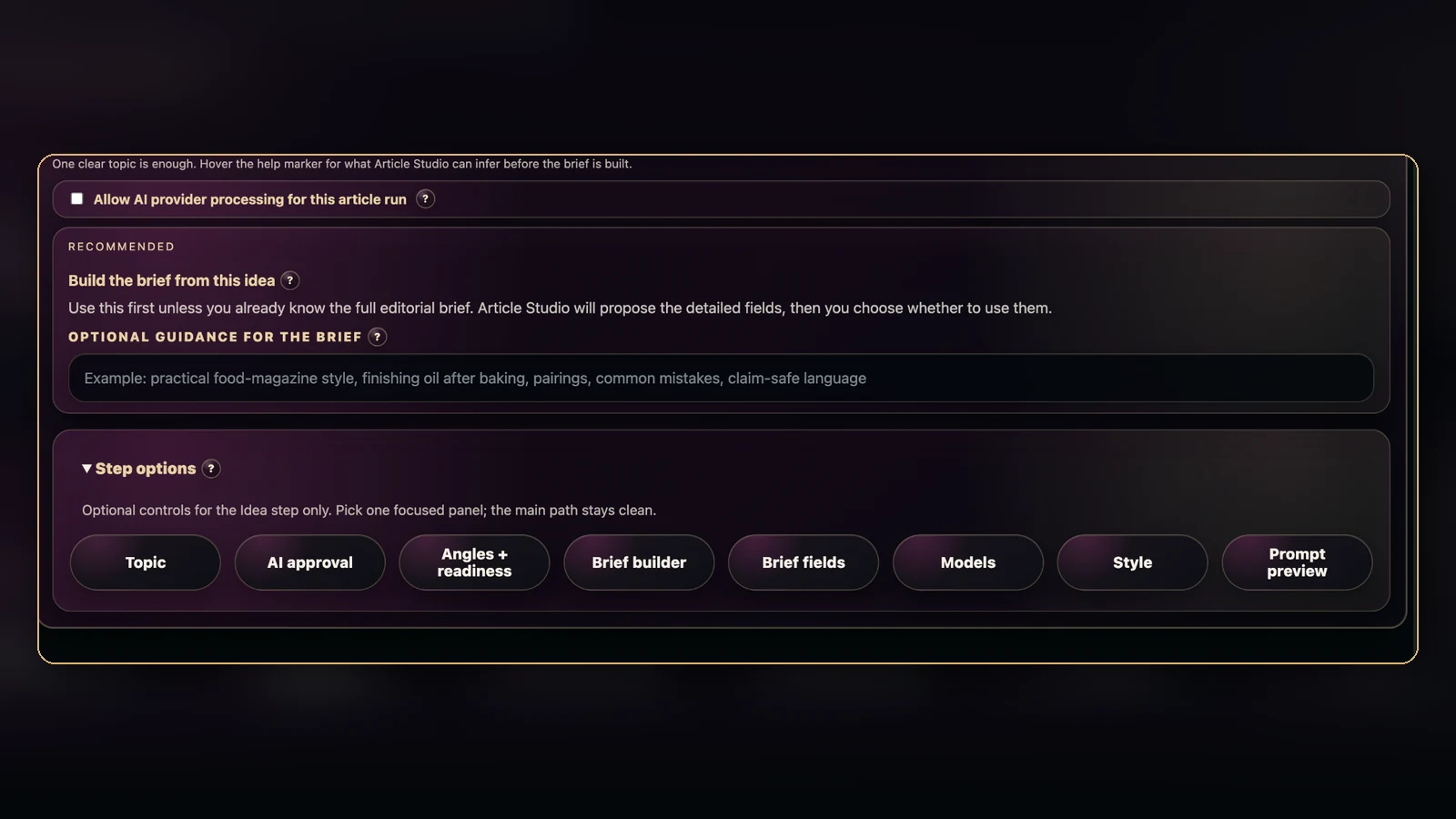
What this proves The creator wizard and detailed brief builder are working administration screens from the real system. They show the eight stages, provider approval, model and style controls, readiness checks, prompt evidence, and the deliberate manual-publish boundary.
PRODUCT PROOF

These are real project views from the actual work—not generic stock illustration. They connect the product story to an interface, workflow, or result a visitor can inspect.